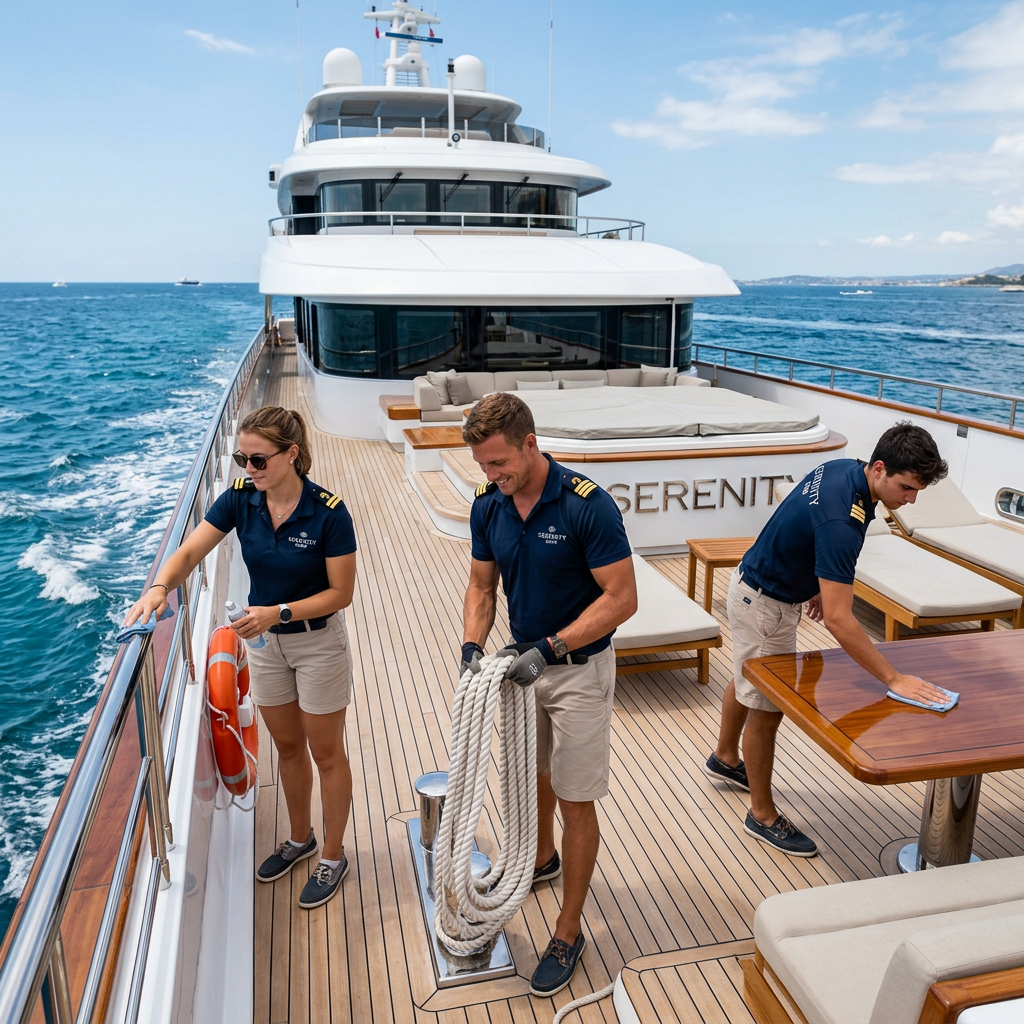
Executive Summary
Below Deck is a cornerstone of American reality television, premiering on Bravo on July 1, 2013. The series chronicles the professional and personal lives of crew members residing and working aboard luxury superyachts during charter seasons. Over 12 seasons and 187 episodes, the show has evolved from a single-camera docuseries into a massive global franchise with five distinct spin-offs.
While the series has enjoyed significant commercial success—peaking in viewership between Seasons 6 and 8—it has faced a bifurcated reception. Critics have categorized it as both an engaging voyeuristic study and a “mundane” or “scripted” representation of the yachting industry. Recent data indicates a downward trend in linear ratings, yet the brand remains a primary asset for the Bravo network and its streaming partner, Peacock.
Series Overview and Core Premise
The series provides an “upstairs-downstairs” look at the maritime industry, focusing on the crew’s efforts to provide “stellar service” to wealthy charter guests while navigating high-stress environments and close-quarters living.
- Format: Episodes typically run 42–54 minutes and often conclude with “Reunion” specials or “The Crew Tells All” episodes featuring unseen footage.
- Production: Managed by 51 Minds Entertainment and Endemol. The series utilizes a mix of experienced maritime professionals and cast members selected for the show.
- Key Locations: The production has filmed across the Caribbean (Sint Maarten, British Virgin Islands, Bahamas, US Virgin Islands, Antigua, St. Kitts) and international locales including Tahiti and Phuket, Thailand.
Production History and Significant Events
Evolution of Leadership and Yacht Vessels
The series was anchored for a decade by Captain Lee Rosbach, who remained on board during the first season even as the original vessel crew was replaced by the television cast. Season 11 marked a significant transition as Captain Kerry Titheradge took over leadership.
| Season | Yacht Name | Location | Notable Leadership |
| 1 | Honor (Cuor di Leone) | Sint Maarten | Capt. Lee Rosbach |
| 2 | Ohana | British Virgin Islands | Capt. Lee Rosbach |
| 3 | Eros | Bahamas | Capt. Lee Rosbach |
| 4-5, 7 | Valor | USVI / Sint Maarten / Thailand | Capt. Lee Rosbach |
| 6, 8-9 | My Seanna | Tahiti / Antigua / St. Kitts | Capt. Lee Rosbach |
| 10 | St. David | Saint Lucia | Capt. Lee / Capt. Sandy Yawn |
| 11-12 | St. David | Grenada | Capt. Kerry Titheradge |
Critical Incidents
- Season 6 Safety Crisis: During filming in Tahiti, deckhand Ashton Pienaar nearly died after being dragged into the water by a tow line. He was saved by cameraman Brent Freeburg, who freed the line before it could sever Pienaar’s foot or cause him to bleed out. This led to the institution of stricter safety procedures.
- COVID-19 Impact: Season 8 was curtailed after the final two charters were canceled due to the onset of the global pandemic.
- Production Staffing: For Season 1, producers booked a five-week charter where the original crew was given time off and replaced by the cast, though the Captain, First Officer, and Engineer remained to ensure vessel safety.
The Below Deck Franchise
The success of the original series has led to the development of several spin-offs, expanding the brand into different maritime niches:
- Below Deck Mediterranean (2016): Focuses on cruising grounds in the Mediterranean Sea.
- Below Deck Sailing Yacht (2020): Features a crew aboard the sailing yacht Parsifal III in Greece.
- Below Deck Down Under (2022): A Peacock original series filmed in Australia.
- Below Deck Adventure (2022): Focuses on extreme excursions alongside yachting service.
Key Personnel and Casting
The series relies on a recurring “core” of department heads to maintain continuity:
- Captain Lee Rosbach: The face of the franchise for the first ten seasons.
- Kate Chastain: Served as Chief Stewardess for six seasons (S2–S7), becoming one of the show’s most recognizable figures.
- Ben Robinson: The original Chef, appearing across multiple seasons and spin-offs.
- Eddie Lucas: Progressed from Deckhand to First Officer over several seasons.
- Fraser Olender: Transitioned from 2nd Steward to Chief Steward, maintaining his role through the most recent seasons (S10–S12).
Critical Reception and Industry Impact
Television critics have offered varied assessments of the series’ quality and authenticity:
- The “Voyeuristic” Appeal: Rob Owen of the Pittsburgh Post-Gazette described it as a “fairly entertaining, voyeuristic look” at a made-for-reality-TV crew. David Wiegand of the San Francisco Chronicle noted the show successfully capitalizes on “friction and sexual tension.”
- Authenticity Concerns: Emily Yahr (The Washington Post) characterized the show as “neatly wrapped-up ‘plotlines’” that are difficult to take seriously. Neil Genzlinger (The New York Times) argued that while the crew might be interesting, the guests are often “insufferable.”
- Professional Reputation: Sandy Malone, writing for The Huffington Post, raised concerns that the behavior depicted on the show—specifically regarding service standards—might be “destroying [the yachting industry’s] reputation for stellar service.”
Ratings and Audience Performance
Nielsen Media Research data indicates that the show reached its commercial peak mid-run, with a noticeable decline in linear viewership in the 2020s.
- Peak Performance: Season 6 and Season 7 were high points for the series. Season 6, Episode 11 reached 2.11 million viewers. Season 7 maintained a high average of 1.56 million viewers per episode.
- Recent Trends: Viewership has seen a significant downward trajectory in the most recent seasons.
- Season 11: Averaged 0.78 million viewers.
- Season 12: Averaged 0.61 million viewers.
Despite the drop in linear ratings, the show continues to hold a faithful international audience, particularly in Canada, where it transitioned from the E! network to the Slice network to match the U.S. Bravo time slots.
Man Overboard: How Below Deck Broke the Fourth Wall and Redefined the Reality TV Powerhouse
We’ve always been obsessed with how the 0.1% spends their weekends, but Below Deck did something braver: it turned the camera 180 degrees toward the people carrying the silver service trays. Since its 2013 debut, this Bravo juggernaut hasn’t just chronicled the lives of “yachties”; it has exposed the friction of a hidden labor class serving the ultra-wealthy. What started as a niche docu-series has evolved into a sprawling global franchise, proving that the real drama isn’t just about who is sleeping in the crew mess—it’s about the high-stakes, high-pressure reality of keeping a multi-million dollar vessel afloat while the guests demand another round of espresso martinis.
The Great Yacht Swap: Production Overboard
The logistics of bringing Below Deck to life are as massive as the vessels themselves, requiring a calculated dance between reality and maritime law. For the inaugural season in Sint Maarten, producers chartered a 50-meter (164-foot) yacht that would become the series’ first star. But the ship viewers knew as Honor was actually the Cuor di Leone, and its operation was a masterpiece of behind-the-scenes engineering.
To turn a working superyacht into a television set, the original crew was given time off and replaced by our cast. However, this wasn’t a total takeover. You can’t just hand the keys of a $20 million vessel to a reality cast and hope for the best.
“The yacht was renamed Honor for the purposes of filming… The original crew used for the vessel were given the time off, to be replaced by the cast of the series for the duration of filming. [Captain Lee] Rosbach and his first officer and engineer stayed on board the vessel to ensure everything went as planned.”
This created a fascinating, “half-reality” pressure cooker. While stews like Adrienne Gang and Kat Held handled the silver service, the actual safety and technical integrity of the ship remained in the hands of the “invisible” professionals—the Captain, First Officer, and Engineer. This legal necessity highlights the show’s inherent tension: it is a staged environment where the maritime stakes remain terrifyingly real.
Life and Death in Frame: The Ashton Pienaar Incident
Reality TV often relies on manufactured “emergencies”—a missing bottle of Rosé or a slightly cold steak—but Season 6 offered a chilling reminder that the ocean doesn’t care about your production schedule. While filming in Tahiti aboard the My Seanna, deckhand Ashton Pienaar suffered a near-fatal accident that remains the most harrowing moment in the franchise’s history.
As the yacht was underway, Pienaar’s leg became entangled in a tow line, dragging him off the deck and into the water between the massive vessel and its tender. In that moment, the “fourth wall” didn’t just crack; it shattered. Cameraman Brent Freeburg instinctively dropped his gear to free the tow line. It was a direct violation of the “observe, don’t intervene” production protocol, but it was the only reason Pienaar survived. Had that line tightened, it would have severed his leg, leaving him to bleed out in the water in seconds.
This was a counter-intuitive pivot for the genre. In an era of “scandoval” and scripted beefs, this was a moment of unassailable truth that fundamentally shifted viewer trust. Survival superseded the narrative. The aftermath saw Captain Lee Rosbach instituting draconian new safety procedures, proving that on Below Deck, the “reality” is often more dangerous than the “TV.”
The “Insufferable” Guest Phenomenon
While the show is ostensibly about the crew, the true engine of the series is the revolving door of wealthy charter guests. These figures serve as a perfect proxy for our collective class anxieties. Writing for The New York Times, critic Neil Genzlinger hit on a profound irony: the most unbearable people on the boat are often the ones paying for the privilege to be there.
“It’s not actually the crew members—the stars of this series—who are unbearable… but the guests, for whom the word ‘insufferable’ was invented.”
These guests aren’t just foils for the crew’s exhaustion; they are a structural necessity for the show’s class-warfare narrative. We watch to see the crew vent about “primary” guests who treat them like furniture, creating a voyeuristic look at the friction between those who have everything and those who are paid to make sure they never have to lift a finger.
A Multi-Continental Empire: The Spin-off Surge
What began as a single-camera docu-series in the Caribbean has mutated into a multi-continental empire. With spin-offs like Mediterranean, Sailing Yacht, Down Under, and Adventure, the franchise has turned the entire globe into its playground, filming everywhere from Thailand and Tahiti to the fjords of Norway.
The growth has been exponential, with spin-off ratings frequently outpacing the original. This expansion turned the series into what Entertainment Weekly critic Annie Barrett famously dubbed “Saved by the Bell, the Summer Edition: Lost at Sea.” By leaning into the “Summer Edition” vibe—cycling through young, hot, and often incompetent crew members in exotic locales—the franchise found a limitless formula for growth. Whether it’s a sailing vessel in Greece or a motor yacht in St. Kitts, the drama remains the same, but the backdrop keeps the audience hooked.
The Industry’s Identity Crisis
Despite its massive popularity, Below Deck maintains a complicated, often prickly relationship with the professional yachting community. There is a permanent tension between the show as entertainment and the show as a “commercial” for the industry.
Sandy Malone, writing for The Huffington Post, voiced a common insider critique, questioning whether the show’s focus on interpersonal chaos and “spoiled” behavior—specifically citing the conduct of long-time Chief Stew Kate Chastain—actually damages the industry’s reputation for “stellar service.” To the professionals, the show is a cautionary tale that prioritizes a “Chief Stew” who makes waves over one who provides seamless service. For the viewers, of course, a seamless service makes for terrible television.
The Horizon Ahead
As the franchise prepares for its 12th season—scheduled to premiere in June 2025—its legacy is undisputed. Even the COVID-19 pandemic, which curtailed Season 8 when the final charters in Antigua were cancelled, couldn’t sink its momentum. The show has successfully transitioned from the “Captain Lee era” to a new guard of leadership under captains like Kerry Titheradge, proving the format is the true star.
As Below Deck continues to navigate new waters, it leaves us with one final, lingering question: Does the true “reality” of the show lie in the wine-tossed interpersonal drama of the galley, or in the very real, high-stakes dangers of a life lived three feet above the waterline? On this show, the answer is usually both.
Below Deck: Comprehensive Study Guide
This study guide provides an in-depth review of the American reality television series Below Deck. Based on the provided documentation, this guide explores the show’s production history, cast evolution, critical reception, and industry terminology.
——————————————————————————–
Part I: Short-Answer Quiz
Instructions: Answer the following questions in two to three sentences based on the provided source context.
- What is the central premise of the television series Below Deck?
- How did the production of Season 1 handle the staffing of the yacht Cuor di Leone?
- What near-fatal accident occurred during the filming of Season 6?
- How did the COVID-19 pandemic specifically impact the production of Season 8?
- Identify the various spin-off series that have been created within the Below Deck franchise.
- Which cast members from Season 1 returned for the second season?
- What was the nature of the critical disagreement between The Washington Post and the Pittsburgh Post-Gazette regarding the show’s authenticity?
- What leadership change occurred starting in Season 11 regarding the role of the Captain?
- Describe the role of Brent Freeburg during the filming of Season 6.
- How does the broadcast schedule for Canadian viewers differ between the early seasons and the later seasons?
——————————————————————————–
Part II: Answer Key
- Below Deck is an American reality series that premiered on Bravo in 2013, focusing on the lives of crew members who work and reside aboard a superyacht. The show chronicles the professional and personal dynamics of the crew during a high-stakes charter season.
- For the first season, the original crew of the yacht Cuor di Leone (renamed Honor) was given time off and replaced by the cast of the series. However, Captain Lee Rosbach, his first officer, and his engineer remained on board to ensure the vessel’s operations went as planned.
- In Season 6, deckhand Ashton Pienaar was dragged into the water after a tow line wrapped around his leg while the yacht My Seanna was underway. He narrowly escaped death or the loss of a limb because a cameraman was able to free the line, preventing the tension from severing his foot.
- The eighth season, which was filmed in Antigua, had to be curtailed due to the global health crisis. This resulted in the cancellation of the final two charters of the season.
- The franchise has expanded to include several spin-offs: Below Deck Mediterranean, Below Deck Sailing Yacht, Below Deck Down Under, and Below Deck Adventure. These series explore different cruising grounds such as the Mediterranean Sea, Greece, and Australia.
- Four cast members returned for the second season: Captain Lee Rosbach, Chef Ben Robinson, 2nd Stewardess Kat Held, and Eddie Lucas. The second season also introduced long-term cast member Kate Chastain as Chief Stewardess.
- The Washington Post questioned the show’s truthfulness, suggesting it seemed scripted with stereotypical characters and neatly wrapped plotlines. Conversely, the Pittsburgh Post-Gazette viewed it more favorably, describing it as an entertaining and voyeuristic look at a crew made for reality television.
- Starting in Season 11, Captain Lee Rosbach was replaced by Captain Kerry Titheradge. Captain Kerry continued as the lead for Season 12 aboard the yacht St. David.
- Brent Freeburg was a cameraman for the series who is credited with saving Ashton Pienaar’s life during his tow line accident. By freeing the line before the tension pulled it tight, he prevented Pienaar from being pulled under or bleeding to death.
- For the first five seasons, the show aired on the Canadian E! network, often at different times than the US broadcast. Beginning with Season 6, the series moved to the Slice network, where episodes air in the identical time slot as the Bravo US broadcast.
——————————————————————————–
Part III: Essay Format Questions
Instructions: Use the following prompts to develop long-form analytical responses. (Answers not provided).
- The Evolution of Leadership: Analyze the transition of leadership throughout the series, comparing the management styles and tenures of Captain Lee Rosbach and Captain Kerry Titheradge, while also considering the temporary role of Captain Sandy Yawn in Season 10.
- Safety and Protocol in Reality Production: Discuss the ethical and production implications of the Season 6 man-overboard incident. How did this event change onboard procedures, and what does it reveal about the intersection of “reality” filming and maritime safety?
- The “Scripted” vs. “Unscripted” Debate: Evaluate the criticisms regarding the show’s authenticity. Using the reviews from David Hinckley, Emily Yahr, and Sandy Malone, argue whether the “stereotypical” nature of the cast serves as a detriment or a necessity for the show’s commercial success.
- Economic and Industry Impact: Examine the concerns raised by Sandy Malone in The Huffington Post regarding whether Below Deck harms the reputation of the professional yachting industry. Contrast these concerns with the show’s high ratings and global expansion.
- Cast Longevity and Archetypes: Explore the significance of returning cast members like Kate Chastain, Ben Robinson, and Eddie Lucas. How do these recurring figures help establish a narrative “anchor” for a show that otherwise features a rotating cast of junior crew members?
——————————————————————————–
Part IV: Glossary of Key Terms
| Term | Definition |
| Bosun | A senior crew member in charge of the deck department and the maintenance of the exterior of the vessel. |
| Charter Season | The specific period during which a yacht is hired by guests for private trips, forming the timeline for each season of the show. |
| Chief Stewardess | The head of the interior department, responsible for guest service, housekeeping, and managing the junior stewardesses. |
| First Officer | A high-ranking officer on the yacht who assists the Captain in navigation and vessel management. |
| Lead Deckhand | A role within the deck department that holds more responsibility than a standard deckhand but ranks below the Bosun. |
| My Seanna | A specific superyacht used as the primary setting for filming during Seasons 6, 8, and 9. |
| Reunion Episode | A special episode aired at the end of a season where the cast meets to discuss and debate the events that occurred during filming. |
| St. David | The superyacht utilized for filming during the tenth, eleventh, and twelfth seasons of the series. |
| Superyacht | A large, luxurious, professionally crewed motor or sailing vessel; the primary setting for all Below Deck episodes. |
| Tender | A smaller boat carried by the yacht, used for transporting guests or equipment to and from the shore or other vessels. |
| Tow Line | A heavy rope used to pull a tender or other vessel behind the yacht; involved in a major safety incident in Season 6. |
| Valor | A yacht used for filming during several seasons, specifically Seasons 4, 5, and 7. |
Leave a Reply