5 Surprising Truths About the Tyrant Who Built Hollywood’s Golden Age
Introduction: Beyond the Roaring Lion
For decades, the roar of the MGM lion symbolized the unparalleled glamour and power of Hollywood’s Golden Age. It was an era of shimmering stars, epic stories, and an idealized vision of America that captivated the world. The architect of this empire was Louis B. Mayer, a name synonymous with the very idea of the all-powerful studio mogul. As the head of Metro-Goldwyn-Mayer, he presided over the largest and most prestigious dream factory the world had ever seen, manufacturing the myths that would define 20th-century American culture.
But the man behind the myth was a figure of deep and startling contradictions. He was a self-made titan who built his empire on a foundation of “wholesome entertainment,” yet ruled it with an iron fist, manipulating the lives of his stars with a blend of paternalism and cruelty. As Spencer Tracy noted at his funeral, Mayer possessed an almost “furious love” for America, born from the gratitude of an immigrant who escaped poverty. The polished fantasies that flickered on screen were the product of this love, but they were produced through a system of ruthless control and meticulous manufacturing. What is the truth about the man who built Hollywood? The reality is far more surprising, and far darker, than the glamorous films MGM produced.
——————————————————————————–
1. He Started as a Scrap Metal Junk Dealer
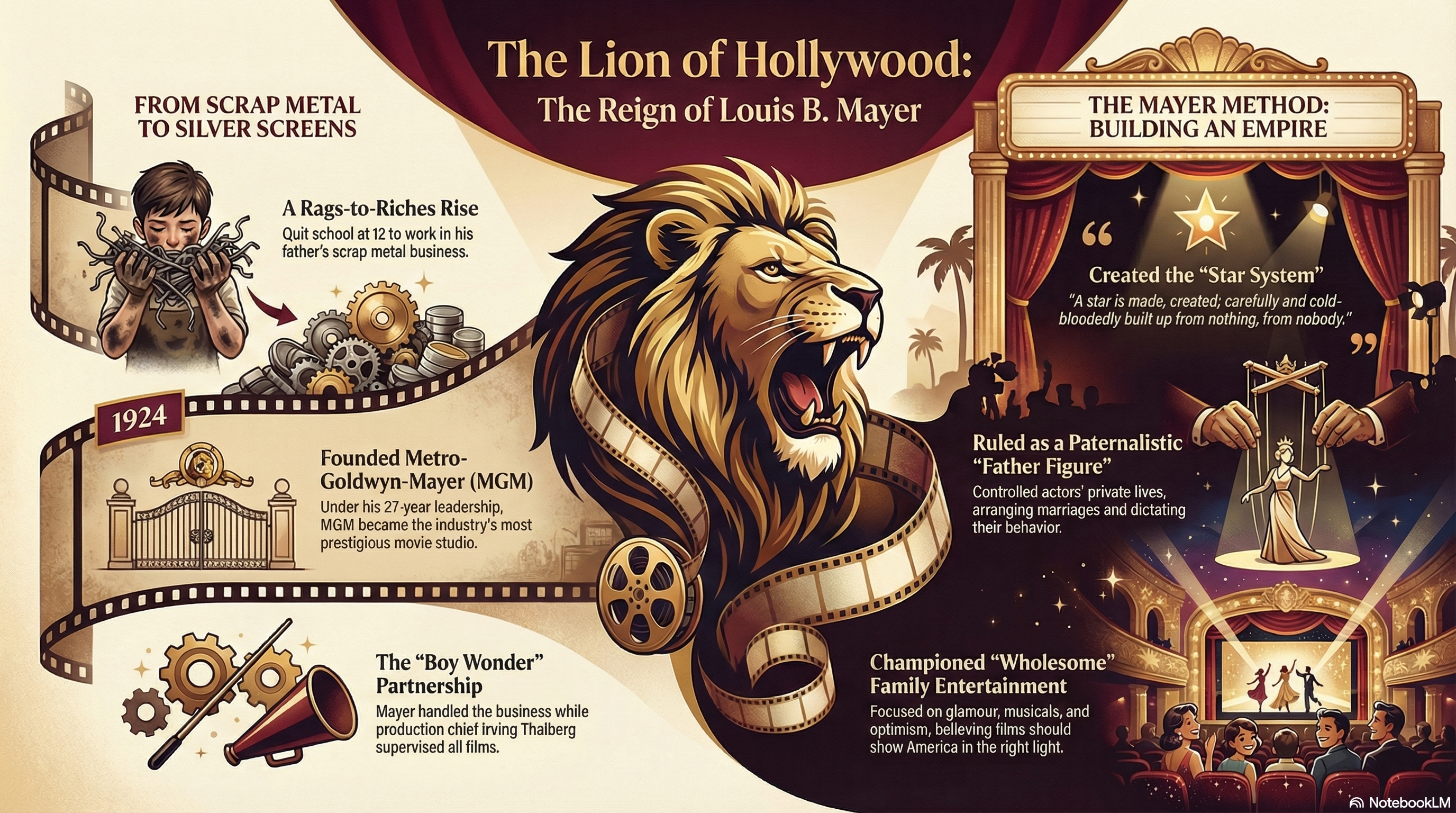
Long before he was a king of Hollywood, Louis B. Mayer was Lazar Meir, a poor immigrant boy struggling to survive. Growing up in poverty in New Brunswick, Canada, he quit school at age 12 to join his father’s scrap metal business, J. Mayer & Son. His first job was not in a grand movie palace, but on the streets, roaming the community with a cart that bluntly advertised his trade: “Junk Dealer.”
This humble work forged not only his ambition but also a surprising capacity for loyalty. One day, the owner of a tin business, John Wilson, took a liking to the boy and began giving him useless copper trimmings. Mayer considered Wilson his “first partner” and best friend. For the rest of his life, whenever he returned to his hometown, Mayer would place flowers on Wilson’s grave, just as he did on his mother’s. This grueling, hand-to-mouth existence was the first step in a relentless climb to unimaginable power, shaping the man who would build a cinematic empire from the ground up.
“If anybody on earth ever created himself, Louis B. Mayer did.” —actress Ann Rutherford
——————————————————————————–
2. He Believed Stars Were “Cold-Bloodedly Built from Nothing”
In the romantic myth of Hollywood, stars are discovered by chance—a fateful encounter at a soda fountain. Louis B. Mayer had no time for such fantasies. Having spent his youth finding value in discarded metal, he applied the same industrial logic to people. He was the chief architect of the “star system,” and his philosophy was that of a master manufacturer. He did not believe stars were born; he knew they were made from raw material.
A beautiful face was simply the starting point. From there, the studio machine would take over, applying the principles of the factory floor to the creation of charisma. In his own words, Mayer detailed the startlingly cynical and industrial process for transforming a “nobody” into a global icon, a formula that reveals his most enduring and unsettling legacy.
“The idea of a star being born is bush-wah. A star is made, created; carefully and cold-bloodedly built up from nothing, from nobody. All I ever looked for was a face. If someone looked good to me, I’d have him tested. If a person looked good on film, if he photographed well, we could do the rest. … We hired geniuses at make-up, hair dressing, surgeons to slice away a bulge here and there, rubbers to rub away the blubber, clothes designers, lighting experts, coaches for everything—fencing, dancing, walking, talking, sitting and spitting.”
——————————————————————————–
3. He Was Both a “Father Figure” and a “Monster”
Mayer’s relationship with his actors was a masterclass in duality. To some, he was a protective, if meddling, patriarch who referred to his contract players as his “boys and girls.” Actor Ricardo Montalbán recalled, “Mr. Mayer was to me like a father.” This paternalism could manifest as genuine compassion; when the great actor Lionel Barrymore was confined to a wheelchair by arthritis, Mayer had the Dr. Kildare stories rewritten specifically to keep him employed.
But this fatherly control had a monstrous shadow. When Mickey Rooney’s off-screen antics threatened the wholesome image of his Andy Hardy character, Mayer grabbed the young star by the lapels and screamed, “You’re Andy Hardy! You’re the United States! You’re the Stars and Stripes. Behave yourself! You’re a symbol!” Elizabeth Taylor, who grew up under his watch, simply called him a “monster.” His treatment of Judy Garland is the most infamous example of his cruelty. To maximize her profitability, he forced her on diets, controlled her with prescription drugs, and subjected her to punishing schedules that ultimately destroyed her. In her unfinished autobiography, Garland stated that he also molested her. This toxic blend of care and abuse was a mechanism for total control.
——————————————————————————–
4. The Film Visionary Who Dismissed TV, Color, and Widescreen
For a man who so completely mastered the medium of film, Louis B. Mayer had a stunningly flawed vision of its future. In a 1932 interview with The Film Daily, as new technologies emerged, he publicly rejected the three innovations that would later redefine the industry. His failure to see what was coming is a classic example of the innovator’s dilemma, where a successful incumbent becomes blinded to the very forces that will disrupt his empire.
His specific dismissals reveal a profound technological blind spot:
- Television: He called it “impractical,” believing the speed required to transmit images would prevent satisfactory results.
- Color Film: He asserted that color had “no place on the screen” except in novelty shorts, arguing it would detract “interest from the story being told.”
- Widescreen: He claimed it “eliminates the intimacy allowed by the standard-sized screen,” useful only for the occasional mob scene.
The irony is immense: the mogul who perfected the Golden Age of cinema failed to recognize the tools that would shape its future and the technology that would one day challenge its dominance.
——————————————————————————–
5. His Propaganda Was Worth “100 Battleships”
When war broke out in Europe, Louis B. Mayer faced immense pressure to remain neutral. Producing anti-Nazi films meant risking 30 to 40 percent of Hollywood’s income from European markets. U.S. movie censor Joseph Breen warned against it, and the U.S. Ambassador to England, Joseph Kennedy, argued that “British defeat was imminent” and antagonizing Germany was pointless. Mayer defied them all.
His most powerful contribution to the Allied cause was the 1942 film Mrs. Miniver. Mayer personally convinced a reluctant Greer Garson to take the matronly lead role, telling her she would embody not just a character, but England itself. “She was a woman who survives and endures,” he told her. “She was London. No, more than that, she was … England!” The film was a massive success, a propaganda masterpiece that galvanized American support for the war. President Roosevelt had prints rushed to theaters, and British Prime Minister Winston Churchill was so moved he sent a telegram directly to Mayer, cementing the film’s place in history.
“Mrs. Miniver is propaganda worth 100 battleships.” —Winston Churchill
——————————————————————————–
Conclusion: The Complicated Legacy of a Hollywood King
Louis B. Mayer was a man of staggering contradictions: a junk dealer who built an empire of dreams, a fiercely loyal friend who emotionally and physically abused his studio’s “children,” and a film visionary who couldn’t see the future of his own medium. He crafted an idealized America on screen through methods that were often tyrannical and exploitative, building a world of glamour on a foundation of industrial ruthlessness. His story is not just the story of MGM, but of the complicated, often brutal, machinery that powered Hollywood’s Golden Age.
He was a creator and a destroyer, a father and a monster. The shimmering world he built has left an indelible mark on global culture, but the cost of that creation remains a dark and complex part of his legacy. How should we remember the architects of our culture when their brilliance is matched only by their tyranny?
The Lion of Hollywood: A Case Study on Louis B. Mayer’s Leadership at MGM
1.0 Introduction: The Mogul Who Defined an Era
Louis B. Mayer was a principal architect of the Hollywood studio system and the co-founder of Metro-Goldwyn-Mayer (MGM), the empire he built into the most prestigious and powerful studio of its time. Under his 27-year reign, MGM defined the golden age of Hollywood, accumulating an unparalleled concentration of writers, directors, and stars. More than a mere movie producer, Mayer was an industrialist whose product was glamour, escapism, and a carefully curated vision of the American dream. This case study will deconstruct Mayer’s strategies in studio growth, talent management, and brand creation to derive actionable lessons for modern corporate leadership.
The following analysis will explore the key pillars of Mayer’s success and eventual decline:
- Strategic Vision: The foundational principles that guided MGM’s growth from a merger into an industry juggernaut.
- Operational Management: Mayer’s distinct, paternalistic leadership style that fostered both loyalty and resentment.
- The Star System: A pioneering model for vertically integrated talent management and human asset development.
- Brand Identity: The cultivation of MGM’s “wholesome entertainment” image that captured the heart of a nation.
- Strategic Decline: The internal and external factors leading to the end of Mayer’s reign and the studio’s golden era.
- Modern Business Lessons: Timeless takeaways from his career on brand-building, talent management, and the perils of strategic rigidity.
Louis B. Mayer’s story is a complex portrait of ambition, innovation, and control. It offers a powerful lens through which to examine the dynamics of building a corporate empire, managing its most valuable and volatile assets, and the ultimate necessity of adapting to a changing world.
——————————————————————————–
2.0 The Architect of an Empire: From Scrap Metal to Studio Head
The vision and early entrepreneurial experience of a founder are critical in shaping a corporate empire’s DNA. Louis B. Mayer’s journey from a poor immigrant family in Canada to the head of Hollywood’s biggest studio was forged through a series of calculated risks and a keen understanding of his market. This section analyzes the foundational business acumen Mayer developed before and during the formation of MGM, which laid the groundwork for its subsequent dominance.
2.1 Early Ventures and Strategic Foresight
Born into poverty, Mayer quit school at age 12 to work in his father’s scrap metal business. This early experience instilled a relentless drive that propelled him into the entertainment business. After moving to Boston, he renovated a rundown 600-seat burlesque house in Haverhill, Massachusetts, reopening it as his first movie theater in 1907. He methodically built this single location into the largest theater chain in New England.
His defining early move came in 1914 when he paid D.W. Griffith $25,000 for the exclusive New England rights to show The Birth of a Nation. This high-risk investment in a controversial but highly anticipated film netted him over $100,000. This move demonstrated an early mastery of arbitrage—identifying an undervalued asset (regional distribution rights) and capitalizing on its true market potential.
2.2 The Formation of MGM and the ‘Quality at Any Cost’ Philosophy
Mayer’s breakthrough into the Hollywood elite was solidified in April 1924, when his Louis B. Mayer Pictures Corporation merged with Metro Pictures and Goldwyn Pictures. Theater chain owner Marcus Loew, who had acquired the other two companies, needed a proven executive to run his new West Coast holdings. Mayer was named head of studio operations and vice president of the new entity: Metro-Goldwyn-Mayer.
From the outset, Mayer and his brilliant young head of production, Irving Thalberg, shared a guiding philosophy that became MGM’s strategic bedrock. Their guiding philosophy was to make the best motion pictures they could at any cost. This commitment to premium product over short-term profit—even if it meant reshooting an entire picture—established MGM as a high-quality studio from its earliest days.
2.3 The Mayer-Thalberg Partnership: A Symbiotic Leadership Model
The professional relationship between Louis B. Mayer and Irving Thalberg was a brilliant team dynamic critical to MGM’s early success. Their skills were perfectly complementary: Mayer, the astute businessman, handled the budgets, negotiations, and overall management of the studio, while Thalberg, the “boy wonder,” supervised all of MGM’s productions with an unparalleled creative vision.
This symbiotic leadership model allowed the studio to balance artistic ambition with commercial imperatives. While their relationship would later fray over philosophical differences, their initial partnership set a powerful precedent, demonstrating how a balance between creative supervision and shrewd business management can fuel explosive corporate growth.
This strategic foundation, built on foresight and a commitment to quality, required a unique operational structure and management style to be executed at scale.
——————————————————————————–
3.0 The Studio as a Factory: Operations and Management Style
At its peak, Metro-Goldwyn-Mayer was less a studio than a self-sufficient industrial city dedicated to the mass production of entertainment. The massive, vertically integrated infrastructure was a direct consequence of the “Quality at Any Cost” philosophy, which required unprecedented resources to execute. This section dissects Louis B. Mayer’s unique management style, evaluating how his hands-on, paternalistic approach created both remarkable stability and significant controversy within this massive operation.
| Operational Metric | Scale at MGM’s Peak |
| Studio Size | 185 acres in Culver City |
| Employees | Approximately 6,000 people |
| Police Force | 50 officers, larger than Culver City’s |
| Power Supply | In-house plant capable of lighting a town of 25,000 |
Mayer’s management of this vast enterprise was a study in duality, combining executive genius with an often-overbearing paternalism.
The Executive Genius
Mayer was considered a formidable executive who could have run any major corporation. He was known for his decisiveness and his practice of leaving department heads alone to do their jobs without interference. He respected talent and intelligence, famously advising a manager, “Never be afraid of hiring a fellow smarter than you are. You’ll only learn from them.” Director Clarence Brown encapsulated Mayer’s executive prowess by comparing him to other industrial titans of his era, noting that, “Like Hearst and Henry Ford… he was an executive genius.”
The Controlling Patriarch
The flip side of Mayer’s leadership was his role as a controlling “father figure.” He meddled deeply in the personal lives of his stars, advising June Allyson to end a relationship with a married man and arranging marriages for others. While some viewed him as a protective father, others found his oversight suffocating and exploitative.
This paternalism had a dark side that represented a critical flaw in his asset management strategy. His infamous temper was widely known, and figures like Judy Garland and Shirley Temple accused him of misconduct. Garland’s experience, in particular, highlights how Mayer’s control prioritized short-term production needs over the long-term sustainability of his most valuable assets. Forced onto diets, given drugs to manage her weight and sleep, and made to work punishing schedules, Garland was treated as a depreciating asset to be exploited, not a human talent to be nurtured. This approach ultimately led to catastrophic value destruction, culminating in her firing and contributing to lifelong personal struggles.
This tight control over the studio’s operations extended directly to its most valuable and volatile assets: the stars themselves.
——————————————————————————–
4.0 Forging Assets: Deconstructing the MGM “Star System”
The “star system” was Louis B. Mayer’s most significant strategic innovation. It was not merely a method for casting films but a deliberate, industrial-scale business process for creating, controlling, and monetizing human assets. This section deconstructs how Mayer engineered a scalable human capital supply chain, transforming artistic talent into a portfolio of predictable, monetizable corporate assets. He rejected the notion of innate star power, viewing it instead as a product to be manufactured. His philosophy was clear and unsentimental:
“The idea of a star being born is bush-wah. A star is made, created; carefully and cold-bloodedly built up from nothing, from nobody…”
Mayer’s system was a meticulously designed production line for manufacturing fame, which can be deconstructed into four key stages:
- Identification: The process began with finding a “face.” Mayer’s primary criterion was photogenic quality; if a person looked good on film, he believed the studio could “do the rest.”
- Development: Once identified, the prospect was handed over to a team of studio experts. Mayer employed “geniuses at make-up, hair dressing, surgeons… coaches for everything—fencing, dancing, walking, talking, sitting and spitting” to methodically construct an aspirational star persona.
- Contractual Control: To protect its investment, MGM signed actors to exclusive, long-term contracts of three or seven years. This ensured the studio had complete control over a star’s professional career, dictating their roles and public appearances.
- Personal Management: The studio’s control extended far beyond the soundstage. Mayer and his team managed the private lives of stars to ensure their public reputations remained pristine and aligned with the MGM brand, intervening in everything from romantic relationships to personal finances.
Strategic Benefits of the Star System
- Bankable Asset Portfolio: The system created a diverse portfolio of bankable stars—including Greta Garbo, Hedy Lamarr, and Mickey Rooney—who could guarantee box office success and de-risk production investments.
- Consistent Talent Pipeline: It ensured MGM had a reliable supply chain of talent, reducing reliance on any single actor and giving the studio immense negotiating leverage.
- Brand Equity: This deep bench of stars built immense brand equity, making the MGM lion a seal of quality, glamour, and star power that audiences trusted.
Human Costs and Asset Depreciation
- Destructive Pressures: The case of Judy Garland exemplifies the system’s human toll. To maintain her girl-next-door image and meet grueling production demands, she was subjected to forced diets and prescribed drugs, leading to addiction and mental health crises.
- Exploitation as Strategy: This treatment reveals a core flaw in the model: the system treated human beings as factory components. This exploitation ultimately damaged the studio’s most valuable assets, leading to burnout, public breakdowns, and premature career ends that destroyed long-term value.
The stars created through this system were the primary vehicles for promoting the specific type of content and brand identity that Mayer meticulously crafted for MGM.
——————————————————————————–
5.0 Crafting the Brand: Wholesome Entertainment and the American Ideal
This section analyzes MGM’s brand strategy, which successfully built a powerful emotional moat around its products by aligning content with the prevailing socio-economic needs of its target market—namely, the desire for escapism and aspirational optimism during the Great Depression and WWII. This was not an accident but a deliberate content strategy. The studio’s output was designed to provide comfort, reflecting Mayer’s deeply held belief in “wholesome entertainment.”
Mayer’s mission for his films was unambiguous and served as the studio’s core brand promise:
“I am going to make pictures you can take your mother and your children to see… When I send my pictures abroad, I want them to show America in the right light—and not that we are a nation chiefly of drunks, gangsters and prostitutes.”
This mission was executed through a consistent focus on several key themes that came to define the MGM brand:
- Family Values: MGM films consistently venerated mothers and portrayed marriage as sacrosanct. This was most famously exemplified by the wildly popular Andy Hardy series starring Mickey Rooney.
- Optimism and Escapism: Mayer believed audiences wanted to be comforted, not challenged. MGM’s formula relied on spectacle, sentiment, and optimism to provide a reliable escape from hardship.
- Glamour and Beauty: The “star system” was central to the brand, delivering aspirational figures of impeccable beauty and glamour like Greta Garbo and Hedy Lamarr.
- The Musical Genre: Musicals became a cornerstone of the MGM brand and are considered Mayer’s greatest contribution to posterity. The Arthur Freed unit produced a string of classics like An American in Paris and Singin’ in the Rain that defined the genre.
5.1 Strategic Pivot: World War II and Propaganda
MGM’s commitment to pure entertainment was tested by the outbreak of World War II. Initially reluctant to produce anti-Nazi films for fear of losing valuable European markets, the studio eventually pivoted to support the Allied cause. This shift culminated in the 1942 production of Mrs. Miniver, a story about a British family’s resilience during the war.
The film was a massive commercial and critical success. More importantly, it was a powerful piece of propaganda. British Prime Minister Winston Churchill praised its impact, sending Mayer a telegram claiming that “‘Mrs. Miniver’ is propaganda worth 100 battleships.” This episode demonstrates Mayer’s ability to align his brand’s messaging with national sentiment for both commercial success and political influence.
However, this deeply entrenched brand identity, so successful for decades, would face significant challenges in the rapidly changing post-war world.
——————————————————————————–
6.0 The Decline of the Lion: A Failure to Adapt
Even the most dominant corporate empires face the threat of decline, often stemming from an inability to adapt to fundamental shifts in the market. Louis B. Mayer, the architect of MGM’s golden age, ultimately fell victim to his own successful formula. This section analyzes the internal and external factors that eroded his power and led to the end of his storied tenure at the studio he built.
The primary causes of Mayer’s decline were rooted in a new post-war reality that clashed with his long-established methods:
- Market Shifts: After World War II, profits for all studios began a gradual decline. By 1947, the number of high-grossing films produced by MGM had dwindled significantly, putting its expensive production model under unprecedented scrutiny.
- Corporate Pressure: As profits fell, MGM’s parent company, Loew’s, Inc., led by Nicholas Schenck, demanded austerity. Schenck’s insistence that Mayer “cut, cut” was fundamentally at odds with Mayer’s entire operational philosophy.
- Strategic Rigidity: Mayer fiercely resisted these pressures, believing that quality could not be compromised. His famous retort to Schenck—”A studio isn’t salami, Nick”—perfectly exemplified his refusal to adapt his “big-picture” model. He had fallen into a competency trap, where the very strategy that built the empire made him incapable of navigating a new economic landscape.
- Internal Power Shift: In 1948, Loew’s hired Dore Schary as vice president in charge of production. Schary championed “message” movies, a stark departure from Mayer’s preferred formula of escapist entertainment. This move signaled a clear shift in corporate strategy and directly undermined Mayer’s authority.
This combination of external market pressures and internal power struggles proved insurmountable. In August 1951, Louis B. Mayer was forced to resign. On his final day, as he walked down a red carpet, the studio’s staff lined the path and applauded him. Actor Turhan Bey’s sentiment captured the gravity of the moment, stating, “In every meaningful way, it was the end of Hollywood.”
His departure marked the end of an era, transitioning his career from a case study in building an empire to a cautionary tale about the refusal to evolve.
——————————————————————————–
7.0 Conclusion: Enduring Lessons from a Hollywood Titan
Louis B. Mayer’s legacy is a study in contrasts. He was a visionary empire-builder who transformed the entertainment industry, yet his methods were often tyrannical and exploitative. He built MGM into the pinnacle of Hollywood by mastering the industrial production of dreams, only to be ousted when he could no longer adapt his formula to a changing world. His story offers a masterclass in corporate strategy, leadership, and the ever-present danger of becoming a victim of one’s own success.
From this complex career, several critical business lessons emerge that remain highly relevant for today’s leaders:
- The Power of a Unified Brand Vision: Mayer’s unwavering commitment to “wholesome entertainment” created one of the most powerful and recognizable corporate brands of the 20th century, demonstrating the immense value of a clear, consistent, and emotionally resonant brand identity.
- Talent as a Manufactured (and Controlled) Asset: The star system provides a powerful, if ethically fraught, blueprint for systematically developing and controlling human capital to create a sustainable competitive advantage.
- The Danger of Strategic Rigidity: Mayer’s inability to adapt his “big-picture” model to post-war economic realities serves as a cautionary tale against the innovator’s dilemma, where a once-successful strategy becomes an immutable and fatal liability.
- The Double-Edged Sword of Paternalistic Leadership: While Mayer’s style fostered loyalty and stability, its extreme control ultimately led to exploitation and stifled individual autonomy, highlighting the inherent risks of a “founder’s syndrome.”
- The Founder’s Paradox: Mayer’s career illustrates how the same vision and control required to build an empire can become the very rigidity that precipitates its leader’s decline, offering a masterclass in both industry creation and the necessity of strategic evolution.
Leave a Reply