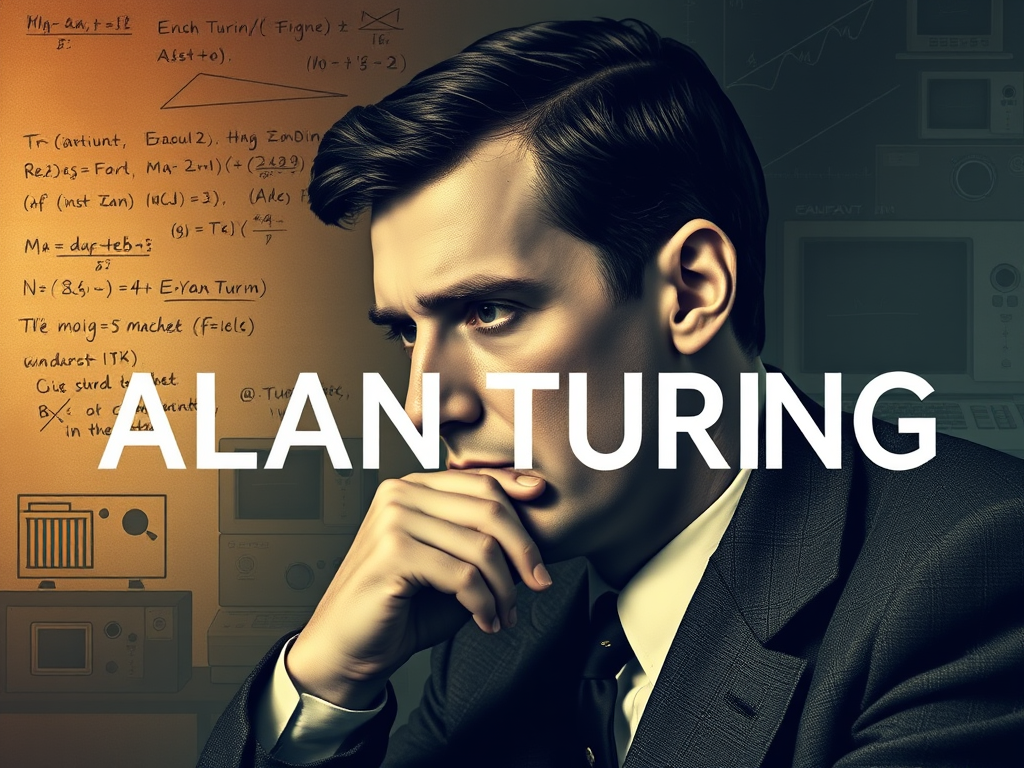
Episode Description
In this episode, we explore the extraordinary life of Alan Turing, the English mathematician widely considered the father of theoretical computer science and artificial intelligence. From his groundbreaking work at Cambridge to his vital contributions during World War II, we examine how one man’s genius shaped the modern world and how a nation’s laws eventually destroyed him.
Key Topics Discussed:
- The Universal Machine: We break down Turing’s 1936 paper, “On Computable Numbers,” where he introduced the concept of the “Turing machine”—a hypothetical device capable of performing any algorithm, which became the model for general-purpose computers.
- Cracking Enigma: Discover Turing’s pivotal role at Bletchley Park, where he led Hut 8 and devised the “bombe,” an electromechanical machine that successfully broke the German naval Enigma ciphers. We discuss how these innovations helped the Allies defeat the Axis powers in the Battle of the Atlantic.
- Artificial Intelligence: We look at Turing’s post-war work, including his creation of the “Turing test” to determine if a machine can exhibit intelligent behavior indistinguishable from a human.
- Mathematical Biology: Learn about Turing’s later interest in morphogenesis, where he used mathematical equations to predict how patterns, such as spots and stripes, form in biological organisms.
- Persecution and Pardon: We detail the tragic end of Turing’s career following his 1952 conviction for “gross indecency” due to his homosexuality. The episode covers his sentence of “chemical castration,” his death by cyanide poisoning in 1954, and the Royal pardon granted posthumously in 2013.
Join us as we discuss the man whose work shortened the war in Europe by years and whose legacy is now immortalized on the Bank of England £50 note.
Alan Turing: A Synthesis of Life, Work, and Legacy
Executive Summary
Alan Mathison Turing (1912–1954) was a seminal English mathematician, computer scientist, logician, and cryptanalyst whose work laid the theoretical and practical foundations for the digital age. Widely considered the father of theoretical computer science and artificial intelligence, Turing formalized the concepts of algorithm and computation with the Turing machine, a model for a general-purpose computer. During World War II, his genius was the driving force behind the Allied codebreaking efforts at Bletchley Park, where he led the vital Hut 8 section. His innovations, including the design of the electromechanical bombe, were crucial in breaking the German Enigma code, particularly the naval ciphers that threatened Allied supply lines in the Battle of the Atlantic. Historians estimate this work shortened the war by more than two years.
After the war, Turing designed the Automatic Computing Engine (ACE), one of the first designs for a stored-program computer, and explored the philosophical questions of machine intelligence, proposing the “Turing test” as a standard for determining if a machine can think. In his final years, he pioneered the field of mathematical biology with his work on morphogenesis.
Despite his monumental contributions, Turing’s life was marred by tragedy. In 1952, he was prosecuted for homosexual acts, which were criminal in the UK at the time. To avoid prison, he accepted chemical castration through hormone treatments. This conviction stripped him of his security clearance and overshadowed his final years. He died in 1954 from cyanide poisoning in a death ruled a suicide, a verdict that has since been questioned. Turing’s work remained largely secret for decades, but he has since received widespread posthumous recognition. In 2009, the British government issued a formal apology for his treatment, followed by a royal pardon from Queen Elizabeth II in 2013. The “Alan Turing law” of 2017 retroactively pardoned thousands of other men convicted under similar historical anti-homosexuality laws, cementing his legacy as both a scientific titan and a pivotal figure in the history of LGBTQ+ rights.
I. Biographical and Academic Foundations
Alan Turing was a multifaceted intellectual whose contributions spanned logic, mathematics, computer science, and biology. His academic journey and personal development were marked by early signs of genius, formative relationships, and groundbreaking theoretical work that predated the physical existence of modern computers.
| Biographical Detail | Information |
| Full Name | Alan Mathison Turing |
| Born | 23 June 1912, Maida Vale, London, England |
| Died | 7 June 1954 (aged 41), Wilmslow, Cheshire, England |
| Cause of Death | Cyanide poisoning, officially ruled a suicide (verdict disputed) |
| Education | University of Cambridge (MA), Princeton University (PhD) |
| Fields | Logic, mathematics, cryptanalysis, computer science, mathematical and theoretical biology |
| Key Institutions | University of Manchester, Government Code and Cypher School (Bletchley Park), National Physical Laboratory |
| Doctoral Advisor | Alonzo Church |
| Known For | Cryptanalysis of the Enigma, Turing’s proof, Turing machine, Turing test, “The Chemical Basis of Morphogenesis,” Turing pattern, Turing reduction |
Early Life and Education
- Early Genius: Turing displayed prodigious talent from a young age. A primary school headmistress noted, “I have had clever boys and hardworking boys, but Alan is a genius.”
- Sherborne School: At Sherborne, his inclination toward science and mathematics was at odds with the school’s emphasis on classics. His headmaster wrote to his parents: “If he is to be solely a Scientific Specialist, he is wasting his time at a public school.” Nevertheless, Turing solved advanced problems without having studied elementary calculus and grasped Einstein’s work at age 16.
- Christopher Morcom: Turing formed a profound friendship with fellow student Christopher Morcom, described as his first love. Morcom’s sudden death from bovine tuberculosis in 1930 caused Turing great sorrow and galvanized him to pursue the scientific and mathematical topics they had shared. He wrote to Morcom’s mother, “I know I must put as much energy if not as much interest into my work as if he were alive, because that is what he would like me to do.”
University and Foundational Work on Computability
- Cambridge University: Turing studied at King’s College, Cambridge, from 1931 to 1934, where he was awarded first-class honours in mathematics and was elected a Fellow in 1935.
- “On Computable Numbers”: In 1936, Turing published his seminal paper, “On Computable Numbers, with an Application to the Entscheidungsproblem.” This paper introduced the concept of the Turing machine, a formal and simple hypothetical device that could simulate the logic of any computer algorithm. This provided a formalization of the concepts of “algorithm” and “computation” and is considered a foundational document of computer science.
- The Entscheidungsproblem: With this work, Turing proved that there could be no general algorithmic process for determining whether all mathematical statements are provable, thus solving David Hilbert’s famous “decision problem.” He proved that the halting problem for Turing machines is undecidable.
- Church-Turing Thesis: His work, developed concurrently with that of Alonzo Church, led to the Church-Turing thesis, which states that any function that is naturally regarded as computable can be computed by a Turing machine.
- Princeton University: From 1936 to 1938, Turing studied under Alonzo Church at Princeton, earning his PhD for a dissertation that introduced the concept of ordinal logic and relative computing.
II. World War II Cryptanalysis at Bletchley Park
During World War II, Turing was a leading figure at Bletchley Park, the British codebreaking center. His work was indispensable to the Allied war effort, providing vital “Ultra” intelligence derived from intercepted German communications.
Leadership and Key Contributions
- Hut 8: Turing was the head of Hut 8, the section responsible for German naval cryptanalysis. His colleague Hugh Alexander stated, “…if anyone was indispensable to Hut 8, it was Turing.”
- The Bombe: Building on pre-war Polish work, Turing specified the design for the bombe, an electromechanical machine that automated the process of breaking Enigma ciphers. The bombe searched for correct rotor settings by testing possibilities against a likely fragment of plaintext (crib), detecting logical contradictions to rule out incorrect settings. Over 200 bombes were in operation by the war’s end.
- Naval Enigma: Turing tackled the particularly difficult German naval Enigma, solving its complex indicator system in December 1939. He found this challenge appealing “because no one else was doing anything about it and I could have it to myself.”
- Banburismus: He developed a sequential statistical technique he called Banburismus to make more efficient use of the bombes. This method used a measure of “weight of evidence” to rule out certain Enigma rotor sequences, significantly reducing the time needed to find a key.
- Turingery: In 1942, he devised a method for breaking the sophisticated Lorenz cipher, used for high-level German communications. This technique, known as Turingery, helped work out the cam settings of the Lorenz machine’s wheels and informed the development of the Colossus, the world’s first programmable digital electronic computer.
- Delilah: Towards the end of the war, Turing helped design and build a portable secure voice communications machine codenamed Delilah. Though it was a technical success, it was completed too late for wartime use.
The “Action This Day” Memo
By late 1941, Turing and his senior colleagues were frustrated by a lack of resources that hampered their ability to decrypt all available signals. On 28 October 1941, they wrote directly to Prime Minister Winston Churchill, bypassing official channels. Churchill’s response was immediate and decisive, a memo to his chief of staff reading: “ACTION THIS DAY. Make sure they have all they want on extreme priority and report to me that this has been done.” This intervention “had an electric effect,” and the necessary resources were promptly provided.
War Impact and Secrecy
- Official war historian Harry Hinsley estimated that the work at Bletchley Park, in which Turing was a central figure, shortened the war in Europe by more than two years.
- Due to the Official Secrets Act, Turing’s work remained classified for many years. He was appointed an Officer of the Order of the British Empire (OBE) in 1946, but the true scale of his wartime contributions was not publicly known during his lifetime.
III. Post-War Innovations in Computing and Biology
After the war, Turing translated his theoretical concepts into designs for the first modern computers and applied his mathematical mind to the mysteries of artificial intelligence and biological development.
Early Computer Design
- Automatic Computing Engine (ACE): Working at the National Physical Laboratory from 1945 to 1947, Turing presented the first detailed design for a stored-program computer, which he named the ACE. Though the full version was not built until after his death, a smaller Pilot ACE executed its first program on 10 May 1950.
- Manchester Computers: In 1948, Turing joined the Computing Machine Laboratory at the University of Manchester, where he became deputy director and worked on software for the Manchester Mark 1, one of the earliest stored-program computers.
Artificial Intelligence and the Turing Test
- “Computing Machinery and Intelligence” (1950): In this landmark paper, Turing addressed the question “Can machines think?” He proposed an experiment, now known as the Turing test, to define a standard for machine intelligence.
- The Test: A human interrogator engages in a natural language conversation with two other parties, one a human and one a machine. If the interrogator cannot reliably distinguish the machine from the human, the machine is said to have passed the test.
- Turochamp: As early as 1948, Turing began writing a chess program, Turochamp. Lacking a powerful enough computer, in 1952 he “ran” the program himself, flipping through algorithm pages and executing instructions on a chessboard. The program “played a recognizable game of chess,” according to Garry Kasparov.
Mathematical Biology and Morphogenesis
- “The Chemical Basis of Morphogenesis” (1952): In his final years, Turing turned to mathematical biology. He proposed that a reaction-diffusion system, where two chemicals diffuse across a space at different rates, could spontaneously create stable patterns like spots and stripes, explaining the development of shapes in biological organisms.
- Legacy in Biology: This work is considered a seminal piece in mathematical biology. It has been used to explain patterns on animal coats, the branching of lungs, and digit formation in limbs. A 2023 study involving chia seeds provided the first experimental verification of his mathematical model with living vegetation.
IV. Prosecution, Persecution, and Death
Turing’s profound professional achievements stand in stark contrast to the personal persecution he faced due to his homosexuality, culminating in a criminal conviction that devastated his career and life.
Homosexuality and Indecency Conviction
- In January 1952, after reporting a burglary at his home, Turing acknowledged a sexual relationship with a 19-year-old man, Arnold Murray. At the time, homosexual acts were a criminal offense in the UK.
- Both men were charged with “gross indecency.” Turing pleaded guilty and was given a choice between prison and probation conditional on undergoing hormone treatment.
- He accepted the treatment, a series of synthetic oestrogen injections commonly called “chemical castration.” The treatment, which lasted for a year, rendered him impotent and caused breast tissue to form.
- His conviction led to the removal of his security clearance, barring him from continuing his consultancy for GCHQ, the successor to Bletchley Park.
Death and Contested Verdict
- On 7 June 1954, Turing was found dead in his home at the age of 41. A post-mortem determined the cause of death was cyanide poisoning.
- An inquest ruled his death a suicide. A half-eaten apple was found by his bed, leading to speculation that it was the means of ingestion, though the apple itself was never tested for cyanide.
- Alternative Theories: The suicide verdict has been challenged. Philosopher Jack Copeland and others argue that the evidence is also consistent with accidental inhalation of cyanide fumes from an electroplating experiment Turing was conducting in a spare room. His mother always maintained that his death was accidental. Biographer Andrew Hodges has theorized Turing may have deliberately made his death appear accidental to spare his mother’s feelings.
V. Posthumous Vindication and Legacy
Decades after his death, a growing appreciation for Turing’s contributions led to a series of official acts to rectify the injustice he suffered and celebrate his monumental legacy.
Government Apology and Royal Pardon
- Apology: In 2009, following a public campaign, British Prime Minister Gordon Brown issued an official public apology for “the appalling way he was treated,” stating, “we’re sorry, you deserved so much better.”
- Royal Pardon: On 24 December 2013, Queen Elizabeth II signed a posthumous royal pardon for Turing’s conviction, an extremely rare measure. Lord Chancellor Chris Grayling stated Turing deserved to be “remembered and recognised for his fantastic contribution to the war effort” and not for his conviction.
The “Alan Turing Law”
The campaign for Turing’s pardon inspired broader action. The term “Alan Turing law” is now informally used to refer to the UK’s Policing and Crime Act 2017, which retroactively pardoned tens of thousands of men convicted under historical legislation that outlawed homosexual acts.
Enduring Recognition
- Scientific Father Figure: Turing is universally recognized as the father of theoretical computer science and a pioneer of artificial intelligence.
- Cultural Honours: His legacy is celebrated widely. He is the face of the Bank of England’s £50 note, first issued on his birthday in 2021. Statues honor him at Bletchley Park and in Manchester.
- Greatest Scientist: A 2019 BBC series audience vote named Alan Turing the greatest scientist of the 20th century.
Notable Quotations on Turing
- Douglas Hofstadter, Cognitive Scientist: “It is fair to say we owe much to Alan Turing for the fact that we are not under Nazi rule today.”
- Asa Briggs, Historian and Codebreaker: “You needed exceptional talent, you needed genius at Bletchley and Turing’s was that genius.”
- Peter Hilton, Bletchley Park Colleague: “It is a rare experience to meet an authentic genius. … one realizes that one is in the presence of an intelligence, a sensibility of such profundity and originality that one is filled with wonder and excitement. Alan Turing was such a genius.”
Beyond the Enigma: 5 Things You Never Knew About Alan Turing
Introduction: The Genius We Think We Know
When we hear the name Alan Turing, a specific image forms in our minds: the quiet, brilliant mathematician, the hero of Bletchley Park who cracked Germany’s Enigma code and shortened World War II by years. This picture, immortalized in film and history books, is undeniably true and profoundly important.
But to remember him only as the Enigma codebreaker is to see a masterpiece in thumbnail. The full portrait reveals a man of staggering intellectual breadth and surprising physical endurance, a visionary whose ideas outpaced the technology of his era, and a human being whose tragic end was far more complex than the simple story we’ve been told. To truly understand Alan Turing is to look beyond the ciphers and discover the intricate, often counter-intuitive, facets of his life that reveal the true measure of his genius and his humanity.
1. He Was a World-Class Marathon Runner
Long before he was a national hero, Alan Turing was a formidable endurance athlete of world-class caliber. This was not a casual hobby; his running was a core part of his being. In 1948, he tried out for the British Olympic team, and his marathon time was only 11 minutes slower than the time that earned the British silver medallist his place on the podium. His colleagues knew him as the man who would occasionally run the entire 40 miles to London for high-level meetings. This physical discipline was not separate from his intellectual life; it was the essential outlet for the immense pressure of his cognitive work. His running was a coping mechanism, a way to balance the relentless workings of his mind. When asked why he trained so hard, his answer was direct and revealing:
I have such a stressful job that the only way I can get it out of my mind is by running hard; it’s the only way I can get some release.
2. He Didn’t Just Break Codes; He Invented Entire Fields
While his wartime cryptanalysis was vital, Turing’s most profound legacy lies in the disciplines he essentially willed into existence. His intellectual journey was a relentless exploration of the very nature of logic, thought, and life. Long before the war, his 1936 paper introduced the “Turing machine,” an abstract model of a general-purpose computer that established the theoretical bedrock for what we now call computer science. After the war, he ventured from the mechanics of computation into the philosophy of thought itself, asking if a machine could think. His 1950 paper proposed the “Turing test,” a standard for artificial intelligence that continues to provoke debate to this day. Then, in a final, breathtaking pivot, he turned his gaze from machines to nature, becoming a pioneer in mathematical biology. He was fascinated by morphogenesis—how organisms get their shape. He theorized that simple chemical reactions and diffusions could create the complex patterns we see in the natural world. It was this foundational work that other scientists, like James Murray, would later use to explain the very mechanics of how animals like cats get their spots and stripes.
3. He Programmed a Chess A.I. Before a Computer Could Run It
Turing’s mind consistently operated years, even decades, ahead of the available technology. In 1948, he and a colleague began writing a chess program called “Turochamp,” designing an artificial mind capable of playing one of humanity’s most complex games. There was just one problem: no computer in existence was powerful enough to run it. When he tried to implement it on a Ferranti Mark 1 computer in 1952, the machine failed. Undeterred, Turing decided to become the computer himself. In an act of extraordinary patience and vision, he manually executed the algorithm on a chessboard, painstakingly flipping through pages of his own code. Each move took him about half an hour to calculate. The program lost a game to a colleague but won against the colleague’s wife. It was a remarkable contrast: the grand vision of artificial intelligence brought to life by the slow, manual labor of its creator. Decades later, grandmaster Garry Kasparov would affirm the quality of Turing’s farsighted work:
[Turing’s program] “played a recognizable game of chess”.
4. His Death Is More Mysterious Than Widely Believed
The official story of Alan Turing’s death is a stark and simple tragedy: suicide by cyanide poisoning, a half-eaten apple found by his bed. Yet this verdict, determined by a swift inquest in 1954, conceals a much deeper mystery. Philosopher Jack Copeland has argued that Turing’s death was likely accidental, caused by inhaling cyanide fumes from a small electroplating apparatus he used in a spare room to plate spoons with gold. Copeland points out that the autopsy findings were more consistent with inhalation than ingestion. Furthermore, the iconic apple was never tested for poison, and Turing often ate an apple before bed, frequently leaving it half-eaten. His mother always insisted the death was an accident caused by careless chemical storage. Friends reported that he had borne his legal troubles with “good humour” and had written a list of tasks he planned to complete after the holiday weekend. Adding another layer of tragic complexity, his biographer Andrew Hodges theorised that Turing may have deliberately staged his death to look accidental, a final, desperate act of love to spare his mother the unbearable pain of knowing her son had taken his own life.
5. His Brutal Persecution and the Long Road to a Pardon
In 1952, the society Turing had helped save turned on him with breathtaking cruelty. After acknowledging a sexual relationship with a man—then a criminal act in the UK—he was convicted of “gross indecency.” He was presented with a horrifying choice: a prison cell or probation conditional on undergoing hormone treatment. He chose the latter, a procedure now known as chemical castration, which involved injections of synthetic estrogen that rendered him impotent and caused him to develop breast tissue. The conviction also stripped him of his security clearance, ending his vital consulting work for the government’s codebreaking agency, GCHQ. It would take more than half a century for an official reckoning. Following a public campaign, Prime Minister Gordon Brown issued a formal apology in 2009 for the “appalling way” Turing was treated.
So on behalf of the British government, and all those who live freely thanks to Alan’s work I am very proud to say: we’re sorry, you deserved so much better.
In 2013, Queen Elizabeth II granted him a posthumous royal pardon. This landmark act paved the way for the “Alan Turing law” in 2017, which retroactively pardoned thousands of other men convicted under the same discriminatory laws.
Conclusion: Pondering a Legacy
Alan Turing was more than the sum of his achievements. He was a world-class athlete who used physical endurance to manage mental strain. He was the father of computer science and AI, a pioneer in mathematical biology, and a war hero. The man behind the legend was more vibrant, more visionary, and more human than we often remember. His story stands as a stark and painful reminder of the chasm between his monumental contributions to freedom and the cruel injustice he suffered at the hands of the society he fought to protect. As we celebrate his legacy, we are left with a powerful, unsettling question: How many other geniuses have we lost or silenced because they didn’t fit the mold of their time?
Alan Turing: A Comprehensive Study Guide
This guide provides a detailed review of the life, work, and legacy of Alan Turing, based on the provided source material. It includes a short-answer quiz with a corresponding answer key, a set of essay questions for deeper analysis, and a comprehensive glossary of key terms.
Short-Answer Quiz
Answer the following questions in two to three sentences, drawing only upon the information provided in the source context.
- What were Alan Turing’s primary contributions to the development of theoretical computer science?
- Describe Turing’s role and the section he led at Bletchley Park during World War II.
- What was the purpose of the “bombe” machine, and how was it an improvement on previous methods?
- Explain the concept and goal of the Turing test.
- What was “Turingery,” and what specific cipher was it developed to counteract?
- Briefly outline Turing’s post-war work in the field of mathematical biology.
- What were the circumstances that led to Turing’s 1952 conviction for “gross indecency”?
- What was the punishment Turing accepted as an alternative to prison, and what were its physical effects?
- Summarize the conflicting theories regarding the cause of Turing’s death in 1954.
- What is the “Alan Turing law,” and what did it accomplish?
——————————————————————————–
Answer Key
- Turing’s primary contributions were the formalization of the concepts of algorithm and computation through the Turing machine, which is considered a model of a general-purpose computer. His 1936 paper “On Computable Numbers” proved that a “universal computing machine” could perform any conceivable mathematical computation if it were representable as an algorithm, and also proved that the halting problem is undecidable. For these achievements, he is widely considered the father of theoretical computer science.
- During World War II, Turing was a leading participant in breaking German ciphers at Bletchley Park. He led Hut 8, the section specifically responsible for German naval cryptanalysis. His work was crucial in cracking intercepted messages, which enabled the Allies to defeat the Axis powers in key engagements like the Battle of the Atlantic.
- The “bombe” was an electromechanical machine that Turing specified to break the German Enigma cipher more effectively. It searched for the correct rotor, plugboard, and other settings of an Enigma message by using a fragment of probable plaintext (a “crib”) and performing a chain of logical deductions. It was an improvement on the pre-war Polish “bomba” method and became a primary tool for attacking Enigma-enciphered messages.
- The Turing test is an experiment proposed by Turing to define a standard for a machine to be called “intelligent.” The idea was that a computer could be said to “think” if a human interrogator, through a text-based conversation, could not reliably distinguish the machine’s responses from those of a human. A reversed form of this test, CAPTCHA, is now widely used on the internet.
- “Turingery” was a technique devised by Turing in July 1942 for “wheel-breaking”—working out the cam settings of the wheels of the Lorenz SZ 40/42 cipher machine. This teleprinter rotor cipher machine was codenamed “Tunny” at Bletchley Park. This work was instrumental in the thinking that led to the development of the Colossus computer.
- After the war, Turing turned to mathematical biology, publishing “The Chemical Basis of Morphogenesis” in 1952. He was interested in how patterns and shapes develop in biological organisms, suggesting that a reaction-diffusion system of chemicals could account for these phenomena. His work predicted oscillating chemical reactions and has been applied to explain patterns like spots and stripes on animal fur.
- In 1952, Turing’s house was burgled, and he reported the crime to the police. During the investigation, he acknowledged a sexual relationship with a 19-year-old man, Arnold Murray, who was acquainted with the burglar. As homosexual acts were criminal offences in the United Kingdom at the time, both Turing and Murray were charged with “gross indecency.”
- As an alternative to prison, Turing accepted probation conditional on undergoing hormone treatment, a procedure known as chemical castration. He received injections of stilboestrol (a synthetic oestrogen) for one year. The treatment rendered him impotent and caused breast tissue to form.
- An inquest determined Turing’s death from cyanide poisoning to be a suicide. However, this has been disputed, with alternative theories suggesting it could have been accidental inhalation of cyanide fumes from an electroplating experiment in his spare room. Evidence cited against the suicide verdict includes his “good humour” prior to his death, a list of tasks he intended to complete, and the fact that the autopsy findings were more consistent with inhalation than ingestion.
- The “Alan Turing law” is the informal term for a 2017 law in the United Kingdom that retroactively pardoned men who were cautioned or convicted under historical legislation that outlawed homosexual acts. The law, contained within the Policing and Crime Act 2017, serves as an amnesty law for these historical offences in England and Wales. It followed the posthumous royal pardon granted to Turing himself in 2013.
——————————————————————————–
Essay Questions
The following questions are designed for deeper analysis and synthesis. No answers are provided.
- The Official Secrets Act governed much of Turing’s work and recognition. Using the text, analyze how this act impacted Turing’s ability to communicate his ideas during his lifetime and how it shaped his posthumous legacy.
- Turing is credited with five major cryptanalytical advances during the war. Identify and describe each of these five advances, and evaluate their collective importance to the Allied victory.
- Discuss the stark contrast between Turing’s public contributions and his private persecution. How did his work for the British government stand in opposition to the way that same government’s laws treated him?
- Trace the evolution of Turing’s intellectual interests from his early work on computability and the Entscheidungsproblem to his later research into artificial intelligence and mathematical biology. What common threads or shifts in thinking can be identified across these different fields?
- Examine the campaign for Turing’s government apology and pardon. What were the key arguments made by proponents and the initial counterarguments from the government? How does this historical process reflect changing social and legal attitudes?
——————————————————————————–
Glossary of Key Terms
| Term / Name | Definition |
| Alan Turing law | An informal term for a 2017 law in the UK, contained in the Policing and Crime Act 2017, that retroactively pardons men cautioned or convicted under historical legislation outlawing homosexual acts. |
| Automatic Computing Engine (ACE) | One of the first designs for a stored-program computer, designed by Turing at the National Physical Laboratory between 1945 and 1947. The Pilot ACE, a smaller version, executed its first program in 1950. |
| Banburismus | A sequential statistical technique conceived by Turing to assist in breaking the naval Enigma. It could rule out certain sequences of the Enigma rotors, substantially reducing the time needed to test settings on the bombes. |
| Bletchley Park | The wartime station of the Government Code and Cypher School (GC&CS), Britain’s codebreaking centre, where Turing and his colleagues worked to break German ciphers. |
| Bombe | An electromechanical machine specified by Turing that could break Enigma more effectively than the Polish “bomba.” It searched for possible correct settings of an Enigma message by using a “crib” (a fragment of probable plaintext). |
| Chemical Castration | A procedure involving hormone treatment designed to reduce libido. Turing accepted this treatment, which involved injections of synthetic oestrogen, as an alternative to prison following his conviction for homosexual acts. |
| Christopher Morcom | A fellow pupil at Sherborne School described as Turing’s first love. Morcom’s premature death from bovine tuberculosis caused Turing great sorrow and provided inspiration for his future scientific endeavors. |
| Colossus Computer | The world’s first programmable digital electronic computer, built under the guidance of Max Newman by Tommy Flowers. While not directly designed by Turing, his work on “Turingery” and Banburismus fed into the thinking about cryptanalysis of the Lorenz cipher, which Colossus was built to decrypt. |
| Delilah | A portable secure voice communications machine designed and constructed by Turing and Donald Bayley at Hanslope Park. It was completed too late to be used during the war. |
| Entscheidungsproblem | The “decision problem” originally posed by German mathematician David Hilbert in 1928. Turing proved there was no solution by first showing that the halting problem for Turing machines is undecidable. |
| Enigma Machine | A cipher machine used by Nazi Germany during World War II. Turing’s work at Bletchley Park was central to breaking the ciphers it produced. |
| Government Code and Cypher School (GC&CS) | The British codebreaking organization for which Turing worked, based at Bletchley Park during World War II. It was the predecessor to GCHQ. |
| Gross Indecency | The criminal offence under Section 11 of the Criminal Law Amendment Act 1885 for which Turing was prosecuted in 1952 due to his homosexual relationship with Arnold Murray. |
| Hut 8 | The section at Bletchley Park that Turing led, which was responsible for German naval cryptanalysis. |
| Morphogenesis | The development of patterns and shapes in biological organisms. Turing explored this field in his 1952 paper, “The Chemical Basis of Morphogenesis,” suggesting a reaction-diffusion system could be the cause. |
| Reaction-diffusion System | A system of chemicals reacting with each other and diffusing across space. Turing suggested this system could account for the main phenomena of morphogenesis in biological organisms. |
| Turingery | A technique devised by Turing in July 1942 for working out the cam settings of the wheels of the Lorenz cipher machine (codenamed “Tunny”). |
| Turing Machine | A formal and simple hypothetical device with which Turing provided a formalization of the concepts of algorithm and computation. It is considered a model of a general-purpose computer. |
| Turing Test | An experiment proposed by Turing as a standard for a machine to be called “intelligent.” A computer passes the test if a human interrogator cannot tell it apart from a human being through conversation. |
| Ultra Intelligence | The designation for intelligence produced by the codebreaking efforts at Bletchley Park. Official war historian Harry Hinsley estimated this work shortened the war in Europe by more than two years. |
| Winston Churchill | The Prime Minister of the United Kingdom during World War II. After receiving a direct letter from Turing and his colleagues in 1941, Churchill issued an “ACTION THIS DAY” memo to ensure the Bletchley Park cryptographers received all the resources they needed. |
Leave a Reply