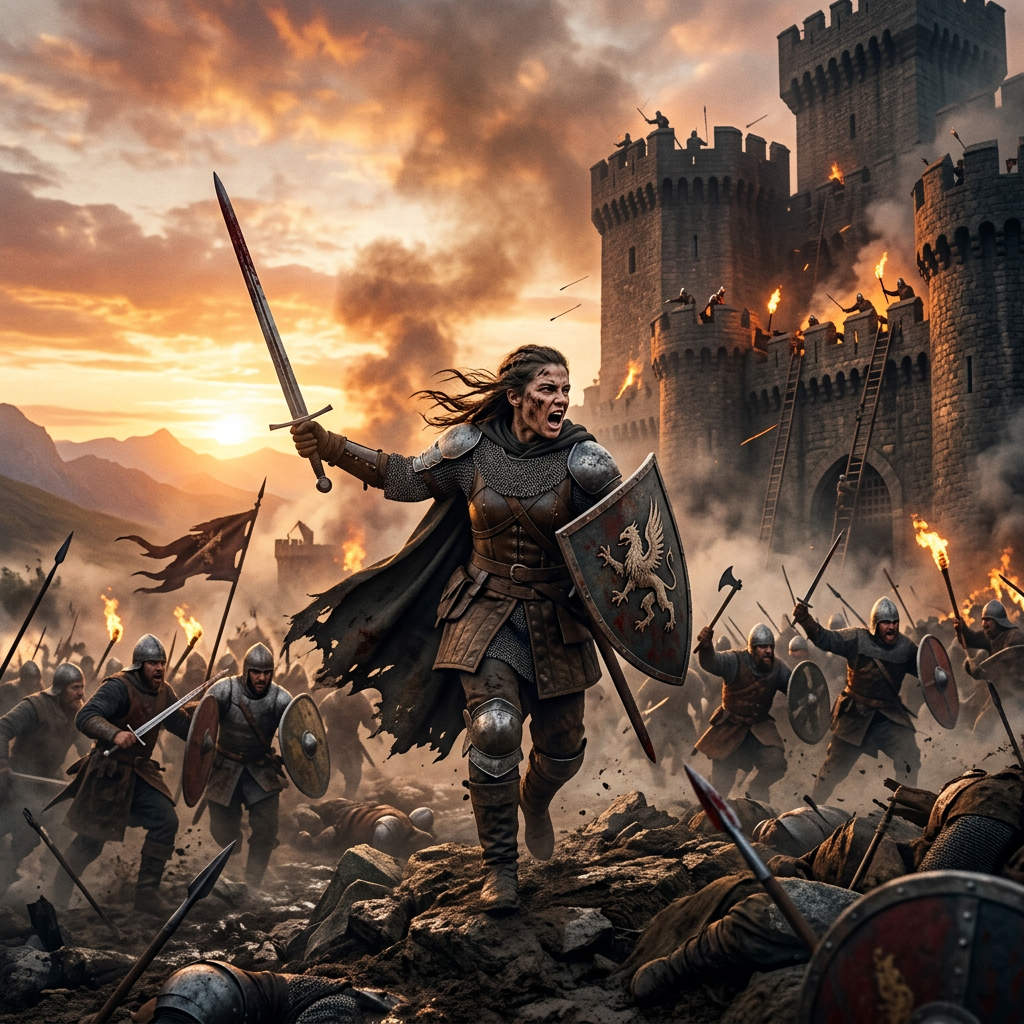
They left at first light, and they did not look back.
Maren watched the column thin to a dark thread along the eastern road, banners snapping, hooves throwing up a mist of frost. Her husband rode near the front beside her two brothers. Her father had pressed the great iron key into her palm the night before, folded her fingers over it, and said the words he thought were kind.
“Keep the hearth warm, daughter. Keep the gates shut. We will be home before the apples fall.”
Keep the hearth warm. As though she were a coal to be banked. She had ridden as well as any of them since she was seven. She knew the weak point in the western wall better than the mason who built it. She knew which of the men drank, which lied about their counts, which would run. And they had handed her a key and told her to wait.
So she waited. She did not do it gently.
The first weeks she walked the walls each dawn and dusk until the watchmen stopped slouching when they heard her step. She emptied the granaries onto a table as figures and found that the steward had been skimming for years; she did not have him hanged, which everyone expected, but set him to counting every grain back, which he found worse. She drilled the household guard — old men, boys, the lame, the ones left behind like her — until they could raise the portcullis chains in half the time. The smith laughed at her the first morning. By the third week he was forging arrowheads through the night and bringing her the count himself.
Word of the war came in pieces, carried by exhausted riders. A victory at the ford. A hard fight in the hills. Then nothing for eleven days, which was its own kind of message.
On the twelfth day a single horse came up the road at a stumble, and the man on it was not a messenger but her youngest brother, grey-faced, an arrow shaft broken off in his shoulder. She had him down and inside before he finished speaking, but she heard enough. The army had not won. The army had been drawn east, far east, chasing a feint — and behind it, slipping down through the northern passes toward the undefended heart of the country, came the thing the feint was meant to hide. Three thousand men. Marching on Aldmere, because Aldmere held the only bridge across the Vell, and whoever held that bridge held the road to every city behind it.
Her father’s army was nine days’ hard ride away. The enemy would arrive in two.
She had perhaps four hundred souls, most of whom could not lift a spear over their heads.
That night she did not sleep, and she did not pray. She spread the maps her father kept locked away — the ones he had never thought to show her — and she read the land the way she read the granary ledgers, looking for the place where the numbers lied. The bridge was the prize, but the bridge was also a throat. The Vell ran deep and fast under it, and the only approach on the near bank funneled down through a cut between two stony rises before it opened onto the crossing. A wide army would have to come narrow there, four men abreast at most, for a hundred yards.
She did not need to beat three thousand men. She needed to beat the few hundred who could fit through the cut at one time, and to do it again, and again, until the river took the rest of their patience.
She sent the smith’s apprentices out the next day to bury the cut in caltrops and stakes by night. She had the herders drive every head of cattle they owned across the bridge and away, so there would be nothing to feed an army that lingered. And she had the old engineers among her left-behind people rig the bridge’s seaward span with pitch and tow and a single rope, so that one stroke of an axe could turn the only crossing into a wall of fire.
When the enemy came on the second evening, they came confident, expecting a frightened garrison behind a shut gate. What they found was the cut filled with iron teeth, and on the rises above it, in the failing light, archers — her old men and her boys and herself among them, bow already drawn — and a woman’s voice, not shouting, just carrying, telling them the bridge was hers and they were welcome to try the river.
They tried the cut first. It cost them more than they could believe. They tried it twice more in the dark and learned the dark was worse. At dawn their commander sent a column wide along the bank to flank the rises, and Maren, who had expected exactly this, gave the order she had been holding all night. The axe fell. The bridge went up in a sheet of flame that lit the underside of the clouds, and three thousand men stood on the wrong side of a river they could not cross, before a fortress they could not take, with no cattle to eat and an army of vengeance now nine — then eight, then seven — days behind them and closing.
They held four more days. Four hundred against three thousand, and the river, and the fear she had taught them to set aside. When her father’s banners finally broke over the eastern hills, the enemy was already a starving, dwindling thing, caught between the Vell and the sword, and the battle that the songs would later call the greatest of the war was, by then, mostly over.
Her father found her on the wall. She had not slept in five days. Her hands were black with pitch and her quiver was empty and she did not let go of the bow.
He looked at the broken bridge, and the burned bank, and the four hundred living souls behind their unbroken gate, and he understood at last what he had left at home.
He went to give her the kind words again. The hearth. The waiting.
She held up the great iron key, still on its cord at her belt, and she smiled at him, tired to the bone.
“The gates stayed shut,” she said. “Just as you asked.”
Leave a Reply