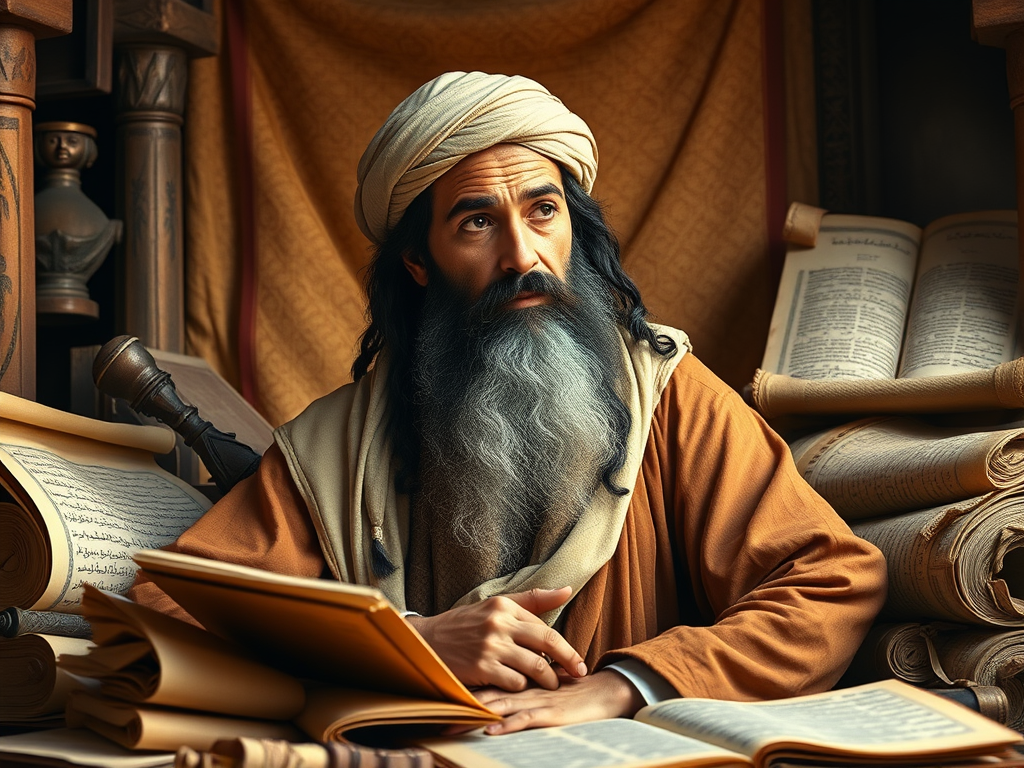
Join us as we explore the life of the preeminent philosopher and physician of the Islamic Golden Age: Ibn Sina, known in the West as Avicenna. Born in the village of Afshana around 980, Avicenna was a child prodigy who memorized the Quran by age ten and mastered medicine by age eighteen.
In this episode, we cover:
- The Father of Early Modern Medicine: We discuss The Canon of Medicine, his massive encyclopedia that diagnosed invisible organisms as causes of disease and served as the standard medical text in European universities as late as 1650.
- The Floating Man: We break down his famous thought experiment that proves self-awareness and the immateriality of the soul by imagining a person suspended in air, isolated from all sensation.
- Metaphysics & Theology: Learn about his distinction between “essence” and “existence,” and his “Proof of the Truthful” argument for the existence of God.
- A Turbulent Life: From serving as a vizier in Hamadan to being imprisoned in a fortress where he wrote the Book of Healing, Avicenna’s intellectual output persisted despite political chaos.
Discover why this Persian polymath influenced thinkers like Thomas Aquinas and was honored by Dante alongside Homer and Plato.
Briefing Document: The Life and Enduring Legacy of Avicenna
Executive Summary
Ibn Sina (c. 980–1037), known in the West as Avicenna, was a preeminent Persian polymath, physician, and philosopher of the Islamic Golden Age. He is widely regarded as one of the most significant thinkers and medical scholars in history. His intellectual corpus, of which approximately 240 of an estimated 450 works survive, spans medicine, philosophy, logic, astronomy, chemistry, psychology, and poetry.
His two most monumental works are The Canon of Medicine, a comprehensive medical encyclopedia that served as a standard textbook in European universities until as late as 1650, and The Book of Healing, a vast philosophical and scientific encyclopedia. Avicenna is often called the “father of early modern medicine” for contributions such as postulating the existence of invisible disease-causing organisms and advocating for the isolation of the sick.
Philosophically, Avicenna was a leading proponent of the Peripatetic (Aristotelian) school. He made profound contributions to metaphysics, most notably his distinction between essence and existence and his ontological argument for God’s existence, the “Proof of the Truthful.” His “Floating Man” thought experiment is a seminal argument for the substantiality and immateriality of the soul and human self-awareness. His work profoundly influenced both subsequent Islamic philosophy and medieval European Scholasticism, shaping the thought of figures like Thomas Aquinas. His legacy endures through numerous institutions named in his honor and his recognition as a central figure in the history of science and philosophy in both the Eastern and Western worlds.
Biographical Overview
Avicenna was born c. 980 in Afshana, a village near Bukhara in the Samanid Empire, to a Persian family. His father was a government official, which provided the young Avicenna with an exceptional education in a thriving cultural and scholarly atmosphere.
- Early Prodigy: By the age of 10, he had memorized the Quran. He studied arithmetic from an Indian greengrocer and Islamic jurisprudence (fiqh) under the Hanafi jurist Ismail al-Zahid. He later studied Greek sciences, including logic and philosophy, under al-Natili, quickly surpassing his teacher and continuing his studies independently. By age 18, he was a well-educated scholar and a practicing physician.
- A Career of Service and Instability: Avicenna’s professional life was marked by service to various Iranian rulers and frequent relocations due to political turmoil.
- Bukhara: At 17, he became a physician to the Samanid ruler Nuh II. After the fall of the Samanid Empire in 999, he moved to Gurganj, the capital of Khwarazm.
- Khwarazm and Gorgan: In Gurganj, he served the Ma’munid ruler and joined a circle of prominent scholars, including al-Biruni. Political necessity forced him to move west around 1012, eventually arriving in Gorgan, where he met his pupil and companion Abu ‘Ubayd al-Juzjani.
- Ray and Hamadan: Around 1014, he entered the service of the Buyid amir Majd al-Dawla in Ray, serving as a court physician. He later shifted allegiance to the amir Shams al-Dawla in Hamadan, who compelled him to become his vizier. This period was fraught with conflict, including clashes with troops and a four-month imprisonment in the fortress of Fardajan after being accused of corresponding with a rival ruler.
- Isfahan: His final and most stable period was in Isfahan, under the patronage of the Kakuyid ruler Ala al-Dawla Muhammad. He served as an advisor and physician, accompanying the ruler on military campaigns.
- Death: In 1037, while accompanying Ala al-Dawla to a battle, Avicenna suffered a severe colic, an ailment that had afflicted him throughout his life. He died in Hamadan, where he was buried.
Core Philosophical Contributions
Avicenna’s philosophy, rooted in Aristotelianism but significantly developed with Neoplatonic elements, became a cornerstone of thought known as Avicennism. He wrote extensively on logic, metaphysics, ethics, and psychology, primarily in Arabic.
Metaphysical Doctrine
Avicenna’s metaphysics is distinguished by its clear separation of essence and existence, a concept that profoundly influenced later philosophy.
- Essence (māhiya) and Existence (wujūd): He argued that the fact of existence cannot be inferred from the essence of a thing. Existence must be imparted to an essence by an external agent-cause.
- Modalities of Being: He established a sophisticated ontological framework based on three modalities:
- Impossibility: That which cannot exist.
- Contingency: That which has the potential to be or not to be (mumkin bi-dhatihi). A contingent being, when actualized, becomes a “necessary existent due to what is other than itself.”
- Necessity: The “Necessary Existent due to itself” (wajib al-wujud bi-dhatihi) is true in itself, is the source of its own being, has no cause, and always exists. This entity is ‘One’ and has no genus, definition, counterpart, or opposite.
Argument for God’s Existence
Known as the “Proof of the Truthful” (burhān al-ṣiddīqīn), this is considered one of Avicenna’s most significant contributions to philosophy. He argued that there must be a “Proof of the Truthful,” an entity that cannot not exist. Through a series of logical arguments, he identified this Necessary Existent with God.
Psychology and the “Floating Man” Experiment
To demonstrate human self-awareness and the immateriality of the soul, Avicenna devised a thought experiment while imprisoned.
- The Scenario: He asked readers to imagine a person created fully formed but suspended in a void, deprived of all sensory input, including contact with their own body.
- The Argument: In this state, the person would have no doubt of their own existence or self. They would affirm their “self” without affirming any physical extension, limbs, or organs.
- Conclusion: This demonstrates that the soul (or the self) is a substance independent of the body, perceived intellectually, and therefore immaterial. The core knowledge “I am” is the essence of a human being.
Logic and Scientific Method
Avicenna significantly advanced the study of logic and the philosophy of science.
- Scientific Inquiry: In The Book of Healing, he diverged from Aristotle’s Posterior Analytics by questioning how one acquires the first principles of a science. He proposed two methods beyond Aristotelian induction (istiqra): examination and experimentation (tajriba). He criticized induction for not leading to absolute universal certainty and instead championed experimentation as a core means of scientific inquiry.
- Temporal Logic: He studied the relationship between temporal propositions and implication, developing an early formal system of temporal logic that became dominant in the Islamic world for centuries and influenced European logicians like Albertus Magnus and William of Ockham.
- Law of Non-Contradiction: He strongly endorsed Aristotle’s law, stating, “Anyone who denies the law of non-contradiction should be beaten and burned until he admits that to be beaten is not the same as not to be beaten, and to be burned is not the same as not to be burned.”
Pivotal Works and Scientific Insights
Avicenna’s two most famous works are encyclopedic in scope and represent the pinnacle of scientific and philosophical knowledge of his time.
The Canon of Medicine (al-Qānūn fī l-ṭibb)
This five-volume medical encyclopedia was a monumental achievement that systematized all contemporary medical knowledge.
- Influence: It became the standard medical textbook in the Islamic world and Europe, used in universities until the 18th century. It remains a foundational text in Unani medicine.
- Key Contributions:
- Germ Theory Precursor: He postulated that invisible tainted organisms were associated with disease.
- Quarantine: He recommended isolating ill individuals to reduce transmission to others.
- Systematic Approach: He explained that causal reasons exist for all medical events, including rare diseases, using polydactyly as an example. This view anticipated Enlightenment-era medical philosophy by seven centuries.
The Book of Healing (Kitāb al-Šifāʾ)
This is Avicenna’s major work on philosophy and science, covering logic, natural sciences, psychology, mathematics, and metaphysics.
- Earth Sciences: He provided a geological explanation for the formation of mountains, attributing them either to “upheavals of the crust of the earth, such as might occur during a violent earthquake” or to the erosive effect of water over a long period.
- Physics:
- Theory of Motion: He developed a theory of motion distinguishing between a projectile’s inclination (mayl) and its force. He argued that motion was the result of an inclination transferred by the thrower and that this motion would not cease in a vacuum. This theory is seen as a precursor to the theory of impetus.
- Optics: He was among the first to argue that light has a finite speed, reasoning that if perception is due to the emission of particles, their speed cannot be infinite.
- Psychology: His psychology grounds the soul in physiology and perception. He detailed a process where external senses supply information to internal senses, which unify the experience. This nexus allows the material body to perceive material objects, while the immaterial soul receives universal forms abstracted through the Active Intellect, a “divine light” that makes universals intelligible.
Other Scientific Contributions
| Field | Contribution |
| Chemistry | – First to derive the attar of flowers via distillation. <br> – Used steam distillation to produce essential oils like rose essence for aromatherapy. <br> – Explicitly disputed the alchemical theory of transmutation, stating, “no change can be effected in the different species of substances.” |
| Astronomy | – Attacked astrology’s power to foretell the future in his Missive on the Champions of the Rule of the Stars. <br> – Argued against Aristotle that stars are self-luminous and believed planets are as well. <br> – Claimed to have observed the transit of Venus in 1032, using it to argue that Venus is sometimes below the Sun in the geocentric model. |
| Poetry | – Wrote poetry in both Arabic and Persian. Almost half of his works are versified. |
Theological Views and Reception
A devout Muslim, Avicenna sought to reconcile rational philosophy with Islamic theology. He aimed to prove God’s existence and creation through logic and scientific reasoning.
- Religious Affiliation: Though his father converted to Isma’ilism, Avicenna identified as a Hanafi Sunni. He memorized the Quran by age 10 and wrote treatises interpreting it through his philosophical system.
- View on Prophets: He argued that Islamic prophets should be considered “inspired philosophers” and held them in higher esteem than other philosophers.
- Criticism: His metaphysical theology was criticized by later Islamic scholars, most notably al-Ghazali, who in his Deliverance from Error branded parts of the philosophy of Avicenna and al-Farabi as “unbelief” and “innovation.” Other critics included Ibn Taymiyya and Ibn Qayyim al-Jawziyya.
Enduring Legacy and Influence
Avicenna is recognized globally as one of history’s great intellectual figures. George Sarton, a historian of science, called him “the most famous scientist of Islam and one of the most famous of all races, places, and times.”
- In the Islamic World: He was the central figure in the long history of the rational sciences in Islam, influencing not only philosophy, logic, and medicine but also rational theology (kalām) and jurisprudence (usūl al-fiqh).
- In Medieval and Renaissance Europe:
- His works were translated into Latin, and a “Latin Avicennism” flourished for a time.
- Dante Alighieri placed him in Limbo in his Divine Comedy alongside other virtuous non-Christian thinkers.
- He was ranked with Hippocrates and Galen as a princeps medicorum (“prince of physicians”) from the 14th to the 16th century.
- His linking of Galen’s medicine with Aristotle’s philosophy in the Canon greatly elevated his importance in medieval European scholarship.
- Modern Reception:
- His name is honored by institutions worldwide, including universities, hospitals, research institutes, and the Avicenna Prize awarded by UNESCO for ethics in science.
- The Avicenna crater on the Moon is named after him.
- Iran donated a “Persian Scholars Pavilion” featuring his statue to the United Nations Office in Vienna.
- He has been depicted in films like The Physician (2013), where he was played by Ben Kingsley.
Leave a Reply