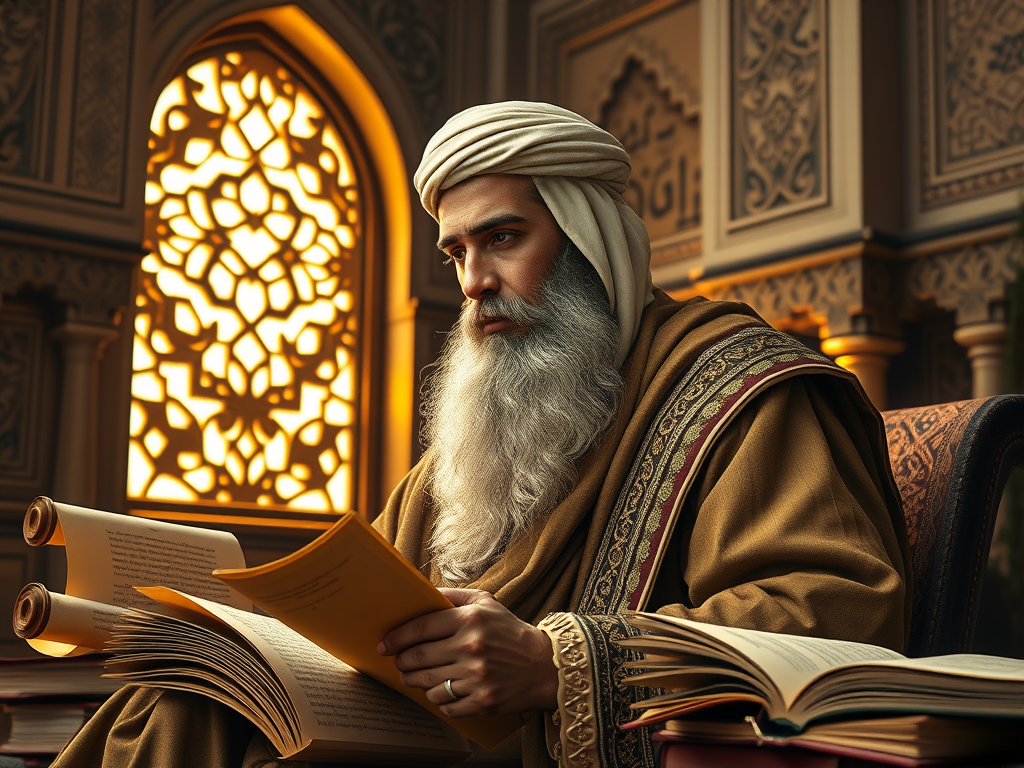
Journey back to the Golden Age of Islam and 12th-century Al-Andalus to explore the life of Ibn Rushd, known to the Western world as Averroes (1126–1198). A towering intellectual figure, Averroes was a jurist, physician, and philosopher whose work bridged the gap between the Islamic world and the European Renaissance.
In this episode, we uncover:
- The “Father of Rationalism”: How Averroes championed the compatibility of religion and philosophy, arguing in his Decisive Treatise that scriptural truth and logical truth cannot contradict one another.
- Restoring Aristotle: His life’s mission to strip away Neoplatonic distortions from Aristotle’s teachings, producing extensive commentaries that earned him the title “The Commentator” in the West.
- The Incoherence of the Incoherence: His famous intellectual duel with the theologian Al-Ghazali, in which Averroes defended philosophy against charges of unbelief.
- Medical & Scientific Innovations: His groundbreaking work as a royal physician, where he identified the retina’s role in vision, described symptoms of Parkinson’s disease, and challenged the Ptolemaic astronomical system.
- A Turbulent Legacy: From his exile by the Almohad court to the rise of “Latin Averroism” in Europe—a movement that influenced thinkers like Thomas Aquinas and Dante, yet faced condemnation by the Catholic Church.
Tune in to understand how this Andalusian polymath became a pivotal link in the chain of global intellectual history.
Briefing Document: The Life and Philosophy of Averroes (Ibn Rushd)
Executive Summary
This document provides a comprehensive overview of the life, works, and intellectual legacy of Abū al-Walīd Muḥammad ibn Aḥmad ibn Rushd (1126–1198), known in the Latin West as Averroes. An Andalusian polymath of the Islamic Golden Age, Averroes was a jurist, physician, and philosopher whose extensive commentaries on Aristotle earned him the epithet “The Commentator” and the title “Father of Rationalism.” His central intellectual project was to demonstrate the harmony between philosophy and religion, arguing that reason and revelation are two distinct but non-contradictory paths to truth.
Key takeaways from his work include his staunch defense of Aristotelianism against the Neoplatonist interpretations of earlier Muslim thinkers, his assertion that philosophy is a religious obligation for the intellectual elite, and his advocacy for the allegorical interpretation of scripture when it appears to conflict with demonstrable reason. His most controversial doctrines included the pre-eternity of the world and the “unity of the intellect,” which posited that all human beings share a single, universal intellect.
While his direct influence in the Islamic world remained modest until the 19th century, his works had a transformative impact on Western Europe. Translated into Latin and Hebrew, his writings reignited interest in Aristotle, fueling the scholastic movement. This gave rise to a controversial philosophical school known as Latin Averroism, which attracted followers for centuries but was formally condemned by the Catholic Church in 1270 and 1277. Averroes’s contributions also spanned medicine, where he first described the function of the retina and the symptoms of Parkinson’s disease, and Islamic law, where he authored a seminal text on the principles underlying legal diversity.
——————————————————————————–
1. Biographical Overview
Early Life and Education
Born on April 14, 1126, in Córdoba, Al-Andalus, Averroes belonged to a family renowned for public service in legal and religious fields. His grandfather, Abu al-Walid Muhammad, was the chief judge (qadi) of Córdoba and imam of the Great Mosque. Averroes received an “excellent” education, studying Hadith, Maliki jurisprudence (fiqh), medicine, and theology. He memorized Imam Malik’s Muwatta and was particularly skilled in the field of legal disputes (khilaf). His education also encompassed Greek philosophy and sciences, and he was familiar with the works of the philosopher Ibn Bajjah (Avempace).
Career and Patronage
Averroes held a series of prestigious official positions within the Almohad Caliphate. His career advanced significantly after being introduced to the Almohad caliph Abu Yaqub Yusuf in 1169 by the philosopher Ibn Tufayl. Impressed by Averroes’s knowledge, the caliph became his patron. When the caliph complained about the difficulty of Aristotle’s texts, he commissioned Averroes to write explanatory commentaries, a task that would define his legacy.
His official appointments included:
- Qadi (Judge): Served in Seville (1169, 1179) and Córdoba (1171).
- Court Physician: Succeeded Ibn Tufayl in 1182.
- Chief Qadi of Córdoba: Appointed in 1182, a prestigious post once held by his grandfather.
Fall from Favor and Death
Despite initial favor under Caliph Abu Yusuf Yaqub, who succeeded his father in 1184, Averroes’s fortune reversed in 1195. He was tried by a tribunal in Córdoba, his teachings were condemned, his works were ordered to be burned, and he was banished to Lucena. Modern scholars attribute this fall primarily to political motivations, suggesting the caliph sought to appease orthodox jurists who opposed Averroes’s rationalist philosophy.
Averroes was restored to the caliph’s favor a few years later and returned to court in Marrakesh. He died shortly thereafter on December 11, 1198. His body was initially buried in North Africa before being moved to Córdoba.
——————————————————————————–
2. Major Works and Contributions
Averroes was a prolific author of more than 100 books and treatises covering a vast range of subjects. Many of his original Arabic works are lost, but survive through Hebrew and Latin translations.
| Field of Study | Key Works | Core Contributions |
| Philosophy/Aristotle | Short, Middle, and Long Commentaries on nearly all of Aristotle’s works (e.g., Physics, Metaphysics, On the Soul); Commentary on Plato’s Republic. | Earned the title “The Commentator.” Systematized Aristotle’s thought, restored it from Neoplatonist interpretations, and made it accessible to a wider audience in the West. |
| Islamic Theology | Fasl al-Maqal (“The Decisive Treatise”); Al-Kashf ‘an Manahij al-Adillah (“Exposition of the Methods of Proof”); Tahafut al-Tahafut (“The Incoherence of the Incoherence”). | Argued for the compatibility of philosophy and Islam. Rebutted al-Ghazali’s critique of philosophy. Criticized Ash’ari theology and presented his own rational proofs for God’s existence. |
| Medicine | Al-Kulliyat fi al-Tibb (“The General Principles of Medicine”), known in Latin as the Colliget. | Became a standard medical textbook in Europe for centuries. Identified the retina as the photoreceptor organ, offered a new theory of stroke, and provided the first description of Parkinson’s disease. |
| Islamic Jurisprudence | Bidāyat al-Mujtahid wa Nihāyat al-Muqtaṣid (“Primer of the Discretionary Scholar”). | Analyzed the differences between Sunni schools of law (madhhabs) and explained the theoretical principles causing their inevitable diversity of opinion. |
——————————————————————————–
3. Core Philosophical Tenets
The Harmony of Philosophy and Religion
Averroes’s most significant philosophical argument is that reason (philosophy) and revelation (religion) are two different methods of reaching the same truth. He famously asserted that “truth cannot contradict truth.”
- Allegorical Interpretation: When the literal text of scripture appears to contradict conclusions reached by reason, the text must be interpreted allegorically. This right of interpretation belongs to the “rooted in knowledge”—the philosophers.
- Three Modes of Discourse: He identified three ways of communicating truth, corresponding to different audiences:
- Rhetorical: Persuasive discourse for the common masses (used by the Quran).
- Dialectical: Debate-based discourse for theologians.
- Demonstrative: Logically deductive discourse for philosophers, providing the highest form of knowledge.
- Religious Obligation: He argued that the Quran itself calls for reflection on nature, making the study of philosophy permissible and even an obligation for those with the intellectual capacity.
Restoration of Aristotelianism
Averroes sought to purify Aristotelian philosophy from what he saw as the distorting Neoplatonist tendencies of earlier Muslim thinkers like al-Farabi and Avicenna.
- He rejected al-Farabi’s attempt to merge Plato and Aristotle’s ideas.
- He extensively criticized Avicenna’s theory of emanation and his view that existence is merely an accident of essence, arguing instead that something exists per se.
The Nature of God and the Universe
- Existence of God: Averroes rejected cosmological arguments common at the time, instead favoring two teleological proofs based on the Quran:
- Argument from Providence: The universe appears finely tuned to support human life, implying a creator who designed it for mankind’s welfare.
- Argument from Invention: The complex design of natural entities (e.g., plants, animals) suggests a deliberate inventor, which is God.
- Pre-Eternity of the World: In a direct rebuttal to al-Ghazali, Averroes argued that the universe has always existed. He contended that the Quran implies only the “form” of the universe was created in a moment of time, while its underlying existence is eternal.
Psychology and the Unity of the Intellect
Averroes’s psychological theories evolved over his career, culminating in his most controversial doctrine: the “unity of the intellect.”
- He argued there is only one material intellect, which is universal, eternal, unmixed with the body, and shared by all human beings.
- Individual thought is explained by a process called fikr (cogitatio in Latin), which is the active consideration of particular things encountered by an individual’s brain.
- This thesis was a primary target of criticism in Latin Christendom, most notably by Thomas Aquinas in his work On the Unity of the Intellect against the Averroists.
Political and Legal Philosophy
- Ideal State: In his commentary on Plato’s Republic, Averroes described an ideal state based on Islamic law (shariah). He equated Plato’s philosopher-king with the ideal imam or caliph.
- Role of Women: Echoing Plato, he called for women to share in all duties of the state, including serving as soldiers, philosophers, and rulers. He lamented that contemporary Muslim societies limited women’s public role, which he saw as harmful to the state.
- Diversity of Law: In Bidāyat al-Mujtahid, he argued that differences between Islamic legal schools were inevitable due to ambiguities in language, varied scriptural interpretations (e.g., general vs. specific commands), and the application of analogical reasoning (qiyas).
——————————————————————————–
4. Scientific Contributions
Astronomy
Averroes was a critic of the Ptolemaic system of eccentrics and epicycles, which he found mathematically sound but physically impossible.
- He sought a physical model of the cosmos based on the Aristotelian principle of uniform, concentric circular motion around the Earth.
- Though he ultimately confessed his attempt to reconcile astronomical observation with Aristotelian physics had failed, his principles influenced the later astronomer Nur ad-Din al-Bitruji.
- He observed the star Canopus from Marrakesh to support Aristotle’s argument for a spherical Earth.
Physics
Described as an “exegetical scientist,” Averroes produced original theories in physics through his detailed commentary on Aristotle. His work introduced important concepts that were influential in the West, including the principles of minima naturalia (the smallest possible part of a natural substance) and motion as forma fluens (a flowing form).
Medicine and Neurology
As a royal physician, Averroes made several pioneering medical observations detailed in his Colliget.
- Retina: He may have been the first to identify the retina, not the lens, as the primary organ responsible for sensing light.
- Stroke: He attributed stroke to cerebral causes, departing from the prevailing Galenic theory.
- Parkinson’s Disease: He provided the first known description of the signs and symptoms of Parkinson’s disease, though he did not name the condition.
——————————————————————————–
5. Legacy and Influence
Influence in the Latin West and the Rise of Averroism
Averroes’s most profound impact was on Christian Europe.
- His extensive commentaries, translated into Latin in the 13th century by figures like Michael Scot, reintroduced the full corpus of Aristotle’s work to a region where it had been largely lost since the fall of the Roman Empire.
- His influence was so immense that he became known simply as “The Commentator.”
- His writings sparked the philosophical movement of Latin Averroism, with major centers in Paris and Padua and prominent followers like Siger of Brabant and Boethius of Dacia.
- The Catholic Church reacted strongly against his ideas. The Bishop of Paris issued condemnations in 1270 and 1277, targeting numerous Averroist and Aristotelian theses.
- Thomas Aquinas relied heavily on Averroes’s interpretation of Aristotle but wrote detailed critiques of his most controversial ideas, particularly the unity of the intellect.
Reception in Jewish Tradition
Jewish scholars received Averroes’s work enthusiastically.
- Maimonides was an early admirer.
- Thirteenth and fourteenth-century Jewish writers, such as Samuel ibn Tibbon, Judah ben Solomon ha-Kohen, and Gersonides, relied heavily on his texts and translations. Jewish Averroism peaked in the 14th century.
Delayed Influence in the Islamic World
Averroes had a minimal impact on Islamic philosophy until modern times for several reasons:
- Geography: He was located in al-Andalus, far from the intellectual centers of the eastern Islamic world.
- Intellectual Context: By the 12th century, the Muslim world had already engaged deeply with Aristotle and had moved on to newer schools of thought, particularly that of Avicenna.
- His works were rediscovered during the Al-Nahda (Arab renaissance) of the 19th century, where he was viewed as an inspirational figure for modernizing Muslim intellectual tradition.
Leave a Reply