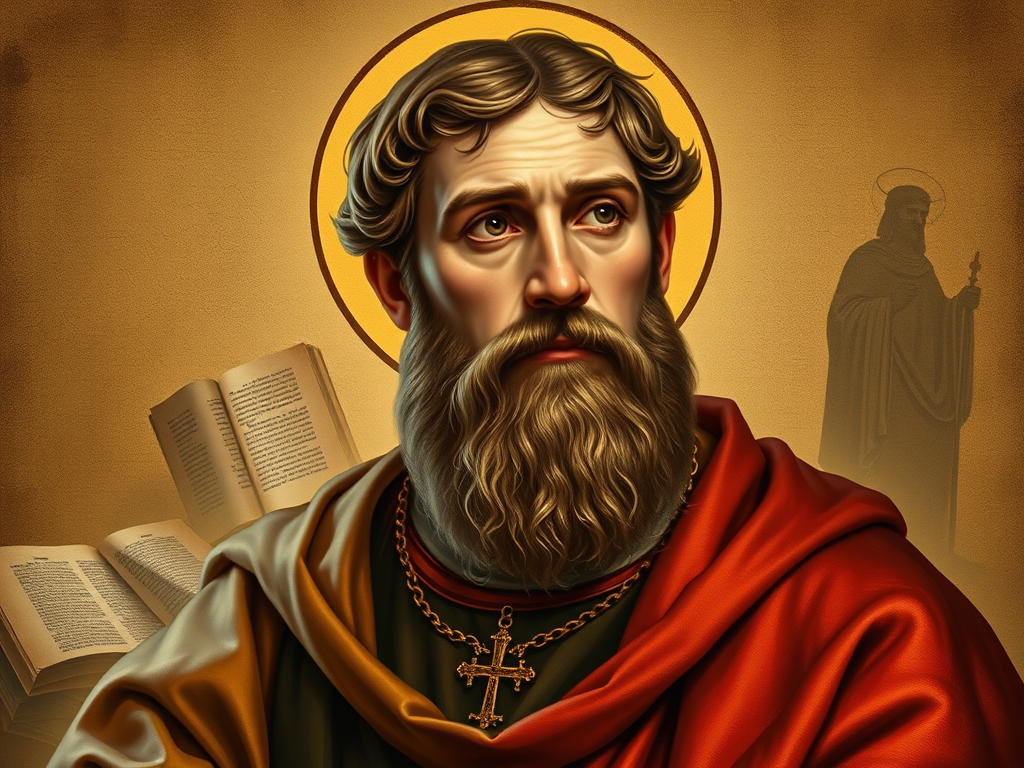
In this episode, we dive into the life and mind of St. Thomas Aquinas, the Italian Dominican friar described as the “greatest of the medieval philosopher-theologians”. Join us as we trace his journey from a young nobleman imprisoned by his family to prevent his religious vocation, to his studies under Albertus Magnus, who famously predicted that this “dumb ox” would one day produce a “bellowing that it will be heard throughout the world”.
We explore Aquinas’s monumental effort to synthesize Aristotelian philosophy with the principles of Christianity, examining his assertion that faith and reason are distinct but complementary tools for understanding God.
Key Topics Discussed:
- The Masterworks: A look at his definitive texts, the Summa Theologiae and the Summa contra Gentiles.
- The Five Ways: Aquinas’s logical arguments for the existence of God, including the concepts of the “First Mover” and the “First Cause”.
- Natural Law and Ethics: Understanding his views on the four cardinal virtues, the “just war” theory, and how human reason participates in eternal law.
- The Mystical End: The profound spiritual experience that led Aquinas to stop writing, declaring that all he had composed seemed like “straw” compared to what he had seen.
Tune in to understand why this “Doctor of the Church” remains a central figure in Western philosophy and theology centuries after his death.
Briefing Document: The Life, Work, and Legacy of Thomas Aquinas
Executive Summary
Thomas Aquinas (c. 1225–1274) was an Italian Dominican friar, priest, and Doctor of the Church, recognized as the foremost Scholastic thinker and one of the most influential philosophers and theologians in the Western tradition. His monumental work sought to synthesize Aristotelian philosophy with the principles of Christianity, establishing a comprehensive intellectual framework that became the foundation of Catholic doctrine for centuries.
Aquinas’s central thesis is that faith and reason are not contradictory but are two complementary paths to understanding truth, both of which ultimately originate from God. He famously articulated this as “grace does not destroy nature, but perfects it.” His most renowned works, the Summa Theologiae and the Summa contra Gentiles, are systematic explorations of theology and philosophy, conceived as a science grounded in both natural revelation (accessible through reason) and supernatural revelation (known through faith).
His key contributions include the quinque viae (Five Ways), a set of logical arguments for the existence of God, and a sophisticated ethical system based on the concept of Natural Law, which posits that humans can discern fundamental moral principles through reason. His thought, known as Thomism, has profoundly shaped Catholic theology, ethics, political theory, and metaphysics. Despite posthumous condemnation and criticism, notably from Bertrand Russell for allegedly prioritizing faith over reason, his influence was solidified by his canonization in 1323 and his elevation to Doctor of the Church in 1567. The Neo-Scholastic revival of the 19th century, particularly through Pope Leo XIII’s encyclical Aeterni Patris, cemented his status as the Catholic Church’s “Universal Doctor,” and his work continues to influence modern virtue ethics, cognitive theory, and law.
I. Biographical Overview
A. Early Life and Dominican Calling (1225–1244)
- Birth and Family: Born Tommaso d’Aquino around 1225 in the castle of Roccasecca, Kingdom of Sicily. He was the youngest son of Landulf VI of Aquino, a knight in service to the Holy Roman Emperor, and Theodora, Countess of Teano. His family intended for him to become the abbot of the Benedictine monastery at Monte Cassino, a prestigious path for a younger son of nobility.
- Education: His education began at age five at Monte Cassino. In 1239, he enrolled at the University of Naples, where he was introduced to the works of Aristotle, Averroes, and Maimonides.
- Joining the Dominicans: At nineteen, influenced by the preacher John of St. Julian, Aquinas resolved to join the nascent Dominican Order. This decision deeply displeased his family, who saw it as a step down in status.
- Imprisonment and Resolve: In 1244, his brothers captured him and held him prisoner in the family castles for nearly a year. They attempted to dissuade him, even hiring a prostitute to seduce him. According to canonization records, Aquinas drove her away with a burning log, after which two angels appeared and girded him with a mystical belt of chastity. Seeing his resolve was unbreakable, his mother arranged a “secret” escape to preserve the family’s dignity.
B. Academic Career and Key Influences (1245–1268)
- Mentorship of Albertus Magnus: In 1245, Aquinas was sent to the University of Paris, where he met the Dominican scholar Albertus Magnus. He followed Albertus to Cologne in 1248. Aquinas’s quiet demeanor led fellow students to nickname him the “Dumb Ox” (bos mutus), prompting Albertus to prophesy: “You call him the dumb ox, but in his teaching he will one day produce such a bellowing that it will be heard throughout the world.”
- First Paris Regency (1256–1259): After returning to Paris to earn his master’s degree, Aquinas was appointed regent master in theology. During this period, he wrote significant works, including Disputed Questions on Truth and began the Summa contra Gentiles.
- Papal Theologian (1259–1268): After leaving Paris, Aquinas served in Naples, Orvieto (where he completed the Summa contra Gentiles and wrote hymns for the feast of Corpus Christi, such as Pange lingua), and Rome. In 1265, Pope Clement IV summoned him to be papal theologian. During this time, while teaching at the Santa Sabina studium provinciale, he began his most famous work, the Summa Theologiae, intended as an instructional text for beginner students.
C. Second Paris Regency and Cessation of Writing (1269–1274)
- Conflict with Averroism: Aquinas was recalled to Paris in 1268 to counter the rise of “radical Aristotelianism” or “Averroism,” which was perceived as a threat to Christian doctrine. He wrote On the Unity of Intellect, against the Averroists to distinguish his use of Aristotle from theirs.
- Mystical Experience: On December 6, 1273, while celebrating Mass in Naples, Aquinas experienced a profound ecstasy. Afterward, he ceased all writing and dictation, famously telling his secretary, Reginald of Piperno: “Reginald, I cannot, because all that I have written seems like straw to me” (mihi videtur ut palea). As a result, the Summa Theologiae remains unfinished.
- Death: Summoned by Pope Gregory X to the Second Council of Lyon in 1274, Aquinas fell ill en route after striking his head on a tree branch. He died at the Cistercian Fossanova Abbey on March 7, 1274.
II. Core Philosophical and Theological Principles
A. The Synthesis of Faith and Reason
Aquinas viewed theology as a science whose raw data consists of scripture and Church tradition. He argued that faith and reason are the two primary tools for understanding this data. His central idea, “gratia non tollit naturam, sed perficit” (“grace does not destroy nature, but perfects it”), encapsulates his belief that rational thinking and the study of the natural world are valid ways to understand God, as God reveals himself through nature.
- Natural Revelation: Truth available to all people through human reason (e.g., knowledge of God’s existence).
- Supernatural Revelation: Truth originating from the Holy Spirit, revealed through the prophets and scriptures, and transmitted by the Church (e.g., the nature of the Trinity and the Incarnation).
B. Metaphysics: The Nature of God
Aquinas believed God’s existence, though self-evident in itself, is not self-evident to humans and must be demonstrated through its effects.
The Five Ways (Quinque Viae)
In the Summa Theologiae, he presents five arguments for God’s existence:
| Argument | Description |
| 1. Motion | Some things are in motion. Nothing can move itself; it must be moved by another. An infinite chain of movers is impossible. Therefore, there must be a First Mover, which is God. |
| 2. Causation | Every effect has a cause. Nothing can be its own cause. An infinite chain of causes is impossible. Therefore, there must be a First Cause, which is God. |
| 3. Necessity | We observe things that are contingent (can exist or not exist). It is impossible for everything to be contingent, or else nothing would exist. Therefore, there must be a necessary being whose existence is not dependent on another, which is God. |
| 4. Gradation | We observe degrees of perfection (goodness, truth, nobility) in beings. These degrees imply the existence of an ultimate standard of perfection, which is God. |
| 5. Ordered Tendencies | Natural bodies, even those without intelligence, act towards an end. This suggests they are directed by an intelligent being. Therefore, there must be an intelligent designer who directs all natural things to their end, which is God. |
Divine Attributes
Following the via negativa (negative theology), Aquinas argued God is best understood by what He is not. He proposed five key statements about God’s nature:
- God is simple: Without composition of parts (e.g., body and soul, matter and form).
- God is perfect: Lacking nothing; in a state of complete actuality. Aquinas defined God as Ipse Actus Essendi subsistens (the subsisting act of being itself).
- God is infinite: Not limited physically, intellectually, or emotionally.
- God is immutable: Incapable of change in his essence or character.
- God is one: Without diversification within himself. God’s essence is the same as his existence.
C. Christology and the Goal of Human Life
- Nature of Jesus Christ: Aquinas affirmed the satisfaction theory of atonement, where Christ’s death was necessary to restore human nature from the contamination of original sin. He argued against various heresies, stating that Christ was truly divine, had a truly human rational soul, and possessed two distinct natures (human and divine) in one real person (hypostasis).
- Goal of Human Life: The ultimate goal of human existence is union and eternal fellowship with God. This is achieved through the beatific vision, a state of perfect, unending happiness experienced after death by seeing the essence of God. This ultimate end orders an individual’s will on earth toward virtues like charity, peace, and holiness.
III. Ethical and Political Framework
A. Ethics and Natural Law
Aquinas’s ethics are grounded in the pursuit of happiness through virtuous living. His framework is built on the concept of Natural Law, which he believed is accessible to human reason.
- First Principle of Action: The self-evident precept that “good is to be done and pursued and evil avoided.”
- Four Kinds of Law:
- Eternal Law: The decree of God that governs all creation.
- Natural Law: The human “participation” in eternal law, discovered through reason. It dictates acting virtuously.
- Human Law: Positive law; the particular determinations of natural law devised by human reason for societies.
- Divine Law: The law specially revealed in the scriptures, necessary to direct human behavior toward its supernatural end.
- Virtue Ethics:
- Cardinal Virtues (Natural): Prudence, justice, temperance, and fortitude.
- Theological Virtues (Supernatural): Faith, hope, and charity. Charity is the ultimate virtue that perfects all others.
B. Political and Economic Thought
- Political Order: Aquinas saw man as a social being. He argued that monarchy is the best form of government, but only when the king is virtuous; a vicious monarch leads to the worst form, tyranny. He held that secular rulers are subordinate to the Church in matters of doctrine and ethics.
- Just Price: In economics, he argued that a price should be just, typically its market price, sufficient to cover the seller’s costs without exploiting a buyer’s pressing need.
- Usury: He condemned the practice of lending money with interest (usury), arguing it was unjust because it amounted to “selling what does not exist.”
- Social Justice: He distinguished between distributive justice (the proportional distribution of common goods from the whole to the part) and legal/general justice (the individual’s contribution to the common good).
IV. Specific and Controversial Doctrines
- Treatment of Heretics: In the Summa Theologiae, Aquinas argued that heresy is a grave sin, worse than forging money. He concluded that heretics, after two warnings, “deserve not only to be separated from the Church by excommunication, but also to be severed from the world by death,” and should be delivered to a secular tribunal for this purpose.
- Forced Baptism: Aquinas argued against the forced baptism of the children of Jews and heretics. He stated it would be an injustice to the parents, who would lose their parental authority, and contrary to natural justice, as a child is naturally part of its father until it can use its own reason.
- Magic and Witchcraft: Aquinas wrote that only God can perform true miracles. While angels and demons can do wonderful things, they do so by manipulating natural things, not by supernatural power. Although his own statements were theoretical, his refutation of the older church doctrine that witchcraft was an illusion was later cited extensively in the Malleus Maleficarum and used by witch-hunters to support their persecutions.
V. Major Works
Though his writing career lasted only about two decades, Aquinas wrote over eight million words. His works are systematic, comprehensive, and have remained central to Western thought.
- Summa Theologiae (1265–1274): His most famous work, a systematic compendium of Catholic theology. Conceived for “beginners,” it covers the existence and nature of God, the goal of human life (theology of happiness), Christology, and the sacraments. It remains unfinished.
- Summa contra Gentiles (1259–1265): A major work of Christian apologetics, intended to explain and defend the Christian faith in terms accessible to those without a background in Christian revelation, particularly appealing to reason and natural philosophy.
- Disputed Questions on Truth (1256-1259): A collection of detailed analyses on various aspects of faith and the human condition.
- Commentaries on Aristotle: Aquinas wrote extensive commentaries on many of Aristotle’s major works, including Metaphysics, Nicomachean Ethics, and On the Soul.
VI. Legacy and Modern Reception
A. Posthumous Influence and Canonization
- Condemnation of 1277: Three years after his death, the Bishop of Paris, Étienne Tempier, condemned 219 propositions, including 20 Thomistic ones, which temporarily damaged Aquinas’s reputation.
- Veneration and Sainthood: By the 14th century, his prestige was restored. Dante Alighieri placed him in the Heaven of the Sun in his Divine Comedy. He was canonized by Pope John XXII on July 18, 1323.
- Doctor of the Church: Pope Pius V declared him a Doctor of the Church in 1567, ranking his feast day with the four great Latin fathers. At the Council of Trent, his Summa Theologiae was placed on the altar alongside the Bible.
B. Influence on the Catholic Church
- Second Scholasticism & Neo-Scholasticism: His work was central to the revival of Scholastic thought in the 16th and 17th centuries. The 19th-century Neo-Scholastic movement received papal backing in the 1879 encyclical Aeterni Patris, in which Pope Leo XIII declared Aquinas’s theology a definitive exposition of Catholic doctrine and mandated its teaching in all seminaries.
- 20th Century and Vatican II: While challenged by the nouvelle théologie movement, Aquinas’s importance remained a point of agreement. The Second Vatican Council’s decree Optatam Totius reaffirmed that theological formation for priests should be undertaken with Aquinas as a teacher. He is one of the most frequently cited authors in the 1997 Catechism of the Catholic Church.
C. Modern Influence and Criticism
- Philosophy: Modern ethicists like Alasdair MacIntyre and Philippa Foot have drawn on his virtue ethics. His principle of double effect remains influential in bioethics and moral philosophy. Cognitive neuroscientist Walter Freeman has proposed Thomism as the system most compatible with neurodynamics.
- Culture: His aesthetic theories influenced writers like James Joyce and Umberto Eco.
- Criticism: The philosopher Bertrand Russell famously criticized Aquinas for engaging in “special pleading” rather than true philosophical inquiry. Russell argued that Aquinas began with his conclusions—the tenets of Catholic faith—and merely sought rational arguments to support them, falling back on revelation when reason failed. He asserted this approach was fundamentally different from the open-ended inquiries of the best Greek or modern philosophers.
Leave a Reply