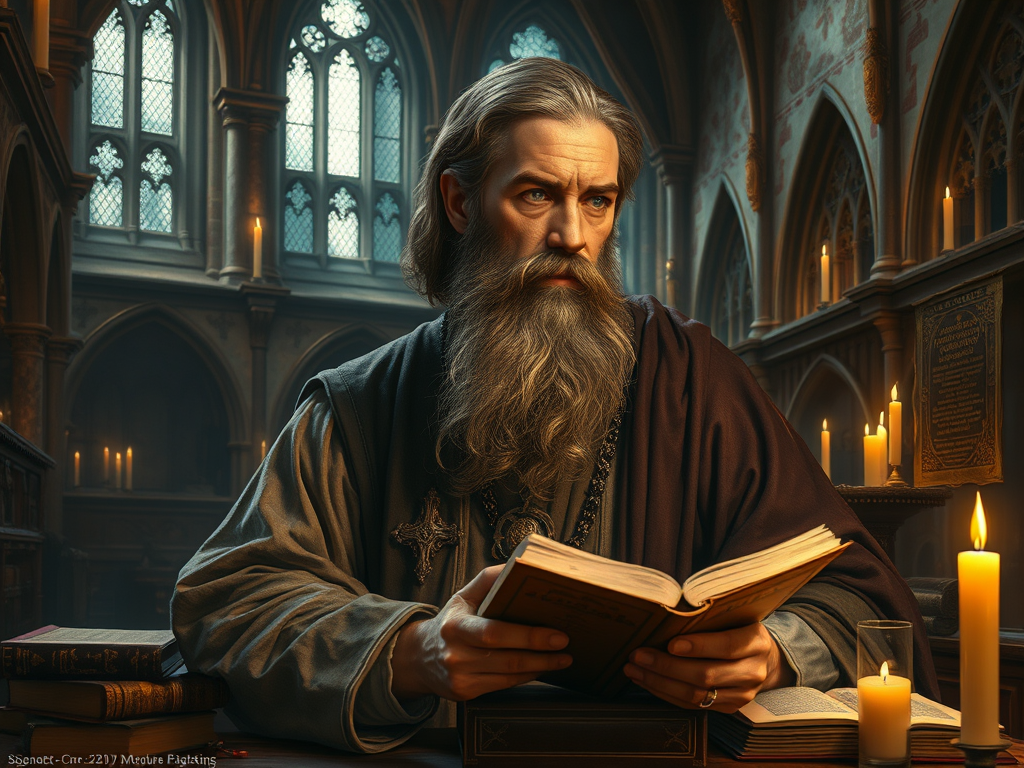
In this episode, we explore the life and legacy of Anselm of Canterbury (1033–1109), a Benedictine monk, philosopher, and the “Father of Scholasticism”. We trace his journey from his early years at the Abbey of Bec, which he transformed into a premier seat of learning in Europe, to his elevation as the reluctant Archbishop of Canterbury in 1093.
Join us as we examine Anselm’s pivotal role in the Investiture Controversy, where his principled defense of the Church’s spiritual independence led to fierce conflicts with English kings William II (Rufus) and Henry I, resulting in two separate exiles from England. We also dive into his revolutionary intellectual contributions, including the Proslogion and Cur Deus Homo, his formulation of the famous “ontological argument” for the existence of God, and his enduring theological motto: “faith seeking understanding”. Finally, we discuss his canonization and his recognition as a Doctor of the Church.
Anselm of Canterbury: A Synthesis of His Life, Philosophy, and Ecclesiastical Career
Executive Summary
Anselm of Canterbury (c. 1033–1109) was an Italian Benedictine monk, abbot, philosopher, and theologian who served as Archbishop of Canterbury and became one of the most luminous intellects between St. Augustine and St. Thomas Aquinas. His career was defined by two parallel and profound struggles: an ecclesiastical one for the independence of the Church against the English monarchy, and an intellectual one to demonstrate the rationality of Christian faith. His efforts in the political realm, particularly his conflicts with Kings William II and Henry I over the Investiture Controversy, resulted in two separate exiles from England but ultimately helped establish key tenets of the Gregorian Reform on English soil.
Intellectually, Anselm is renowned as the “father of Scholasticism” for his rigorous application of reason to theology. He operated under the principle of fides quaerens intellectum (“faith seeking understanding”), asserting that belief must precede reason, but that reason is an essential tool for plumbing the depths of faith. This approach led to two of Western philosophy’s most enduring contributions: the ontological argument for the existence of God, articulated in his Proslogion, which posits God as “that than which nothing greater can be thought”; and the satisfaction theory of atonement, detailed in Cur Deus Homo, which argues that Christ’s death was a necessary satisfaction for the offense to God’s honor caused by human sin. Canonized as a saint in 1494 and declared a Doctor of the Church in 1720, Anselm’s work has profoundly shaped Christian theology and the philosophy of religion.
——————————————————————————–
I. Biographical Trajectory and Ecclesiastical Career
Anselm’s life charts a course from the contemplative world of a monastery to the turbulent center of English politics, where he became a key figure in the Church’s struggle for autonomy.
A. Early Life and Monastic Career at Bec
Born around 1033 in Aosta, Burgundy (modern Italy), Anselm was the son of a Lombard noble, Gundulph, and a devout mother, Ermenberge. After his mother’s death, he left home at age 23 and, after three years of wandering, was drawn by the reputation of Lanfranc of Pavia to the Benedictine abbey of Bec in Normandy.
- Rise through the Ranks: He entered Bec as a novice at age 27. Three years later, in 1063, he was elected prior when Lanfranc became abbot of Caen. In 1078, following the death of the abbey’s founder, Herluin, Anselm was unanimously elected abbot.
- Bec as a Center of Learning: Under Anselm’s leadership, Bec became the foremost seat of learning in Europe, attracting students from across the continent. It was during this period that he composed his foundational philosophical works, including the Monologion and the Proslogion.
- Reputation: His renown grew not only from his intellect but also from his kindly method of discipline and his defense of the abbey’s independence from lay control.
B. Archbishop of Canterbury and the Investiture Controversy
Anselm’s connection to England began with visits to oversee Bec’s lands granted after the Norman Conquest. He made a favorable impression and became the preferred successor to Lanfranc as Archbishop of Canterbury. After Lanfranc’s death in 1089, King William II (William Rufus) left the see vacant, appropriating its revenues.
In 1093, believing he was on his deathbed, William II nominated a reluctant Anselm as archbishop. Anselm accepted only on the condition that the king return seized Church lands, accept his spiritual counsel, and recognize Pope Urban II. This set the stage for a protracted conflict over the rights and independence of the Church.
1. Conflicts with William II (William Rufus)
Anselm’s vision of a Church with its own internal authority clashed directly with William’s desire for royal control.
- Financial Disputes: Almost immediately, William demanded £1000 from Anselm, who offered £500 and refused to “purchase his master’s favour as he would a horse or ass.”
- The Pallium Controversy: Anselm insisted on traveling to Rome to receive his pallium (a symbol of metropolitan authority) from Pope Urban II. William, who had not yet recognized Urban over the Antipope Clement III, forbade it. At the Council of Rockingham (1095), the English bishops sided with the king, but the nobles supported Anselm, resulting in a deadlock. William ultimately recognized Urban in exchange for political concessions, and the pallium was sent to England, where Anselm took it from the altar at Canterbury, avoiding direct bestowal by the king.
- First Exile (1097–1100): After William charged Anselm with providing insufficient knights for a military campaign and refused to permit church reforms, Anselm was given the choice of exile or total submission. He chose exile in October 1097. During this time, he attended the Council of Bari (1098), where he defended the Western doctrine of the Filioque, and completed his masterpiece, Cur Deus Homo.
2. Conflicts with Henry I
Following William Rufus’s death in 1100, his brother Henry I invited Anselm to return. However, conflict erupted anew over the principles of lay investiture.
- Lay Investiture and Homage: Henry I demanded that Anselm do homage for his lands and receive his investiture anew by ring and crozier from the king. Having been influenced by papal councils while in exile, Anselm now refused, citing canon law that forbade lay investiture.
- Negotiations and Papal Stance: Multiple embassies to Pope Paschal II failed to resolve the issue, with the Pope reaffirming the ban on lay investiture.
- Second Exile (1103–1107): After a failed mission to Rome, Anselm was again forbidden from returning to England. He withdrew to Lyon. Pope Paschal II eventually excommunicated the bishops invested by Henry and threatened the king himself, prompting Henry to seek a compromise.
- Resolution: The Concordat of London (1107): An agreement was reached at L’Aigle in 1105 and formalized in London in 1107. Henry I formally renounced the right of English kings to invest bishops with the symbols of their spiritual office (the ring and crozier), while the Church permitted clerics to do homage for their temporal lands. This was a landmark victory for the Church’s independence in England.
Anselm spent his final two years fulfilling the duties of his office. He died on April 21, 1109.
——————————————————————————–
II. Philosophical and Theological Contributions
Anselm is credited as a founder of Scholasticism due to his methodical effort to render Christian tenets of faith as a rational system. His guiding principle, famously articulated in the Proslogion, was “credo ut intelligam” (“I believe that I might understand”), which he derived from St. Augustine.
A. The Arguments for God’s Existence
Anselm developed two distinct and highly influential arguments for the existence of God.
- The Monologion (A Posteriori Argument): Written between 1075–1076, this work attempts to prove God’s existence through reason alone, without appeal to scripture. The argument proceeds from experience, observing that humans judge various things as “good” to different degrees. This implies the existence of a single standard of goodness through which all other goods are measured. This ultimate, supreme good is itself good through itself, and must be the supreme being—God.
- The Proslogion and the Ontological Argument (A Priori Argument): Written in 1077–1078, this is Anselm’s most famous work. Dissatisfied with the chain of reasoning in the Monologion, he sought a single, self-sufficient argument.
- The Argument: He defines God as “id quo nihil maius cogitari possit”—that than which nothing greater can be thought. Even a fool or atheist can understand this concept. However, a being that exists only in the mind is less great than a being that exists in both the mind and in reality. Therefore, for the concept of “that than which nothing greater can be thought” to be coherent, such a being must necessarily exist in reality.
- Gaunilo’s Objection: The monk Gaunilo of Marmoutier parodied the argument in his “Liber pro Insipiente” (“On Behalf of the Fool”), suggesting that by the same logic, one could prove the existence of a perfect lost island, which is absurd.
- Anselm’s Responsio: Anselm replied that Gaunilo misunderstood him. The argument applies uniquely to a necessary being (God), not to contingent things like islands. The concept of God is of the single greatest entity among all existing things, whose non-existence is inconceivable, whereas the non-existence of any other thing is conceivable.
B. The Satisfaction Theory of Atonement: Cur Deus Homo
Written between 1095 and 1098, “Cur Deus Homo” (“Why God was a Man”) presents a rational argument for the necessity of the Incarnation and Crucifixion.
- The Problem of Sin: Human sin, committed against an infinitely majestic God, constitutes an infinite offense. Divine justice demands that this offense be paid for, or “satisfied.”
- Humanity’s Inability: Humans are incapable of making this satisfaction. They already owe God perfect obedience, so they have nothing extra to offer as payment. Furthermore, any satisfaction offered by a finite being would be insufficient to cover an infinite debt.
- The Divine Solution: Only God could make an infinite satisfaction, but it was humanity that owed the debt. Therefore, the solution required a God-man. As a sinless human, Jesus did not owe his life to God. By willingly offering his life, which had infinite value because he was also God, he made a satisfaction that was more than sufficient to cover the debt of human sin.
This theory, which frames atonement in legalistic terms of honor, justice, and restitution, largely supplanted the earlier “ransom theory” (which viewed Christ’s death as a payment to Satan) and has profoundly influenced Western Christian soteriology.
C. Major Written Works
Anselm’s writings, composed as dialogues and meditations, form a coherent philosophical system.
| Work Title | Date(s) | Central Theme(s) |
| Monologion | 1075–1076 | An a posteriori proof for God’s existence based on the reality of goodness and being. |
| Proslogion | 1077–1078 | An a priori proof for God’s existence known as the ontological argument (“that than which nothing greater can be thought”). |
| De Veritate (On Truth) | c. 1080-1086 | Explores the nature of truth as “correctness,” identifying absolute truth with God. |
| De Libertate Arbitrii (On Freedom of Choice) | c. 1080-1086 | Defines free will not as the ability to sin, but as the ability to do good for its own sake. |
| De Casu Diaboli (On the Devil’s Fall) | c. 1080-1086 | Examines rational agency, sin, and justice through the case of the fallen angels. |
| De Fide Trinitatis (On Faith in the Trinity) | 1092-1094 | A defense of Trinitarian doctrine and universals against the nominalist Roscelin. |
| Cur Deus Homo (Why God was a Man) | 1095–1098 | Articulates the satisfaction theory of atonement, arguing for the rational necessity of the Incarnation. |
| De Conceptu Virginali (On the Virgin Conception) | 1099 | Discusses original sin, laying groundwork for the later dogma of the Immaculate Conception. |
| De Processione Spiritus Sancti | 1102 | A defense of the Western doctrine of the procession of the Holy Spirit (Filioque). |
| De Concordia | 1107–1108 | Reconciles divine foreknowledge, predestination, and grace with human free will. |
——————————————————————————–
III. Legacy and Veneration
Anselm’s influence has been both deep and long-lasting, securing his place as a central figure in medieval thought and church history.
- Intellectual Influence: His works were widely copied and influenced nearly all major subsequent Scholastics, including Thomas Aquinas, Bonaventure, Duns Scotus, and William of Ockham. His ontological argument and satisfaction theory remain subjects of intense philosophical and theological debate to this day.
- Historical Scholarship: Modern historians are divided on Anselm’s character. Some, following his biographer Eadmer, see him as a genuinely pious and reluctant leader. Others argue his image of holiness was a carefully crafted tool used by an adept political operator to advance the Church’s agenda.
- Veneration:
- Anselm’s canonization was requested by Thomas Becket in 1163 and formally sanctioned by Pope Alexander VI in 1494.
- Pope Clement XI declared him a Doctor of the Church in 1720, where he is known as the doctor magnificus (“Magnificent Doctor”).
- His feast day is celebrated on April 21 in the Catholic Church and the Anglican Communion.
- Institutions bearing his name, such as the Pontifical Atheneum of St. Anselm in Rome, continue to honor his legacy.
Study Guide: Anselm of Canterbury
Short-Answer Quiz
Answer each of the following questions in two to three sentences, based on the provided source material.
- Who was Anselm of Canterbury, and what were his primary roles during his lifetime?
- Describe the core idea of the ontological argument for the existence of God as presented in Anselm’s Proslogion.
- What was the Investiture Controversy, and how did it lead to Anselm’s conflicts with English kings?
- Explain the main argument of Anselm’s “satisfaction theory of atonement” from his work Cur Deus Homo.
- Who was Gaunilo of Marmoutier, and what was his famous objection to Anselm’s ontological argument?
- How did Anselm characterize the relationship between faith and reason in his philosophical approach?
- What were the Gregorian Reforms, and how did Anselm attempt to implement them in England?
- What events led to Anselm’s first exile from England between 1097 and 1100?
- Describe the compromise reached at L’Aigle in 1105 that helped resolve Anselm’s conflict with King Henry I.
- Besides his philosophical arguments, how did Anselm’s leadership at the Abbey of Bec contribute to its reputation?
——————————————————————————–
Answer Key
- Anselm of Canterbury (c. 1033-1109) was an Italian Benedictine monk, abbot, philosopher, and theologian. He served as the Abbot of Bec in Normandy before becoming the Archbishop of Canterbury from 1093 to 1109. He is now also recognized as a Doctor of the Church.
- The ontological argument posits that God is a being “than which nothing greater can be thought.” Anselm argued that if such a being existed only in the mind, a greater being could be conceived—one that also exists in reality. Therefore, for this being to be truly the greatest, it must necessarily exist.
- The Investiture Controversy was a conflict over whether lay rulers or the Church had the authority to appoint (invest) bishops. Anselm’s insistence that this right belonged to the Church clashed with the desire of English kings William II and Henry I to maintain royal control, leading to repeated conflicts and two periods of exile for Anselm.
- In Cur Deus Homo (“Why God was a Man”), Anselm argued that humanity’s sin was an infinite offense against God’s infinite dignity, requiring an infinite restitution that humans could not provide. Therefore, only a being who was both fully God (to offer an infinite payment) and fully man (to pay on humanity’s behalf), namely Jesus, could satisfy divine justice through his death.
- Gaunilo was a monk who offered the most famous critique of Anselm’s argument. He parodied it by proposing a perfect “lost island” greater than which none can be conceived; by Anselm’s logic, this island must also exist in reality, which is absurd. Anselm replied that his argument applied uniquely to the single greatest entity, God, not to contingent things like islands.
- Anselm held that faith must precede reason, famously stating, “I do not seek to understand that I may believe but believe that I might understand.” He believed that once faith is held, one must then make every attempt to use reason to demonstrate and explore the truths of that faith, a methodology that became central to Scholasticism.
- The Gregorian Reforms were an agenda to increase the Church’s internal authority and independence from lay control. As Archbishop, Anselm championed these reforms by convening a council in London that prohibited marriage and concubinage for clergy, condemned simony, regulated clerical dress, and secured a resolution against the British slave trade.
- Anselm’s first exile was prompted by his conflict with King William II. After William refused to support church reform and tried to fine Anselm for supposedly providing insufficient knights for a military campaign, Anselm resolved to seek counsel from Pope Urban II. William denied him permission, giving him the choice of total submission or exile, and Anselm chose to depart in October 1097.
- At the meeting at L’Aigle, a compromise was reached where King Henry I agreed to forsake lay investiture (the act of giving bishops their symbols of office). In return, Anselm was to seek the Pope’s permission for clerics to do homage to the king for their lands. This agreement was a major step in strengthening the rights of the church against the king.
- Under Anselm’s direction as abbot, Bec became the foremost seat of learning in Europe, attracting students from many nations. Its fame grew not only from his intellectual achievements but also from his kindly method of discipline, his good example, and his spirited defense of the abbey’s independence from lay and archiepiscopal control.
——————————————————————————–
Essay Questions
- Examine the relationship between faith and reason in Anselm’s philosophy. How does his motto, “faith seeking understanding,” encapsulate his approach in major works like the Monologion and Proslogion?
- Analyze Anselm’s political struggles as Archbishop of Canterbury. Compare and contrast his conflicts with William II and Henry I, discussing the key issues, the resolutions, and the long-term impact on the Church’s independence in England.
- Trace the argument and counter-argument surrounding the ontological proof for God’s existence. Detail Anselm’s initial formulation in the Proslogion, Gaunilo’s critique involving the “lost island,” and the substance of Anselm’s reply in the Responsio.
- Discuss the significance of the satisfaction theory of atonement as articulated in Cur Deus Homo. How did this theory differ from earlier models of atonement, and what has been its lasting influence on Christian theology?
- Evaluate Anselm’s legacy as both a church leader and a philosopher. In what ways did he earn the titles “father of Scholasticism” and doctor magnificus (“Magnificent Doctor”)?
——————————————————————————–
Glossary of Key Terms
| Term | Definition |
| Aosta | Anselm’s birthplace, located in the Kingdom of Burgundy (now part of Italy). |
| Archbishop of Canterbury | The highest ecclesiastical office in England, held by Anselm from 1093 to 1109. |
| Bec Abbey | The Benedictine abbey in Normandy where Anselm served as a monk, prior, and eventually abbot. Under his leadership, it became a leading center of European learning. |
| Cur Deus Homo | A major work by Anselm, meaning “Why God was a Man.” It presents his satisfaction theory of atonement, arguing rationally for the necessity of the Incarnation and Crucifixion. |
| Eadmer | Anselm’s chaplain, secretary, and biographer, who wrote the Vita et Conversatione Anselmi Cantuariensis and detailed Anselm’s conflicts with the English kings. |
| Gaunilo of Marmoutier | A Benedictine monk who wrote a famous response to Anselm’s Proslogion, titled “On Behalf of the Fool.” He criticized the ontological argument by parodying it with the example of a perfect “lost island.” |
| Gregorian Reform | A series of Church reforms aiming to increase papal authority and clerical independence from lay control. Anselm championed these reforms in England, focusing on issues like lay investiture, clerical celibacy, and simony. |
| Henry I | King of England who initially continued the conflict with Anselm over lay investiture. He eventually reached the Concordat of London compromise with Anselm after a period of negotiation and a second exile for the archbishop. |
| Investiture Controversy | The major medieval conflict between secular rulers and the Church over the authority to appoint, or “invest,” bishops and other high-ranking clergy with the symbols of their office. |
| Lanfranc | Anselm’s countryman and predecessor as Archbishop of Canterbury. He was prior of Bec Abbey when Anselm arrived, and his reputation attracted Anselm to the monastery. |
| Monologion | One of Anselm’s early philosophical works, originally titled A Monologue on the Reason for Faith. It presents a posteriori arguments for God’s existence and attributes based on the concepts of goodness and being. |
| Neoplatonism | A school of philosophy that heavily influenced Anselm’s worldview, particularly through the works of St. Augustine. It informed his understanding of God as the supreme and single source of all goodness and being. |
| Ontological Argument | The philosophical argument for God’s existence first formulated by Anselm in the Proslogion. It argues that God, defined as a “being than which nothing greater can be thought,” must necessarily exist in reality, not just in the mind. |
| Pallium | A woolen vestment conferred by the Pope on metropolitan bishops, symbolizing their authority and communion with Rome. William II’s refusal to let Anselm travel to Rome to receive it was a major point of conflict. |
| Proslogion | Anselm’s most famous work, meaning “Discourse.” It contains the ontological argument and is written in the form of a direct address to God, encapsulating his method of “faith seeking understanding.” |
| Responsio | Anselm’s reply to Gaunilo’s critique of the ontological argument. In it, Anselm argued that Gaunilo had misunderstood his reasoning, which he claimed applied uniquely and necessarily to God and not to any other conceivable being. |
| Satisfaction Theory of Atonement | The doctrine, systematically developed by Anselm in Cur Deus Homo, that Christ’s death was necessary to satisfy the demands of divine justice for the offense of human sin. |
| Scholasticism | A method of critical thought that dominated teaching in medieval universities, emphasizing dialectical reasoning to resolve contradictions. Anselm is often credited as the founder or “father” of Scholasticism due to his efforts to render tenets of faith as a rational system. |
| Simony | The buying or selling of church offices or sacraments, a practice condemned by the Gregorian Reform and by Anselm at his council in London. |
| William II (William Rufus) | King of England whose desire for royal control over the Church led to severe conflicts with Anselm. His refusal to allow reforms and his appropriation of Church revenues led to Anselm’s first exile. |
The Rebel Saint: 5 Ways Anselm of Canterbury Forged the Modern World
When we picture a medieval philosopher-saint, the image is often one of a remote figure, buried in dusty manuscripts in a cold monastery, contemplating abstract questions far removed from our own world. The name Anselm of Canterbury, who lived a thousand years ago, might seem to be the very definition of this stereotype—a name associated with a single, notoriously difficult argument for the existence of God.
This perception, however, obscures a man of dramatic political conflict, revolutionary ideas, and surprising personal struggles. Anselm was no quiet scholar content to stay within monastery walls. He was a reluctant leader who challenged the most powerful kings of his day, a theological innovator who completely reframed the central story of Christianity, and a moral reformer who fought for social justice. His influence extends far beyond the pages of philosophy textbooks, quietly shaping Western thought, politics, and faith.
This article explores five of the most impactful and unexpected aspects of Anselm’s life and thought. From redefining God to fighting the slave trade, his story reveals a figure far more complex, defiant, and relevant than the dusty caricature suggests.
He Argued for God with Logic Alone
Anselm’s most enduring legacy is his ontological argument, a brief but explosive idea from his work, the Proslogion. He attempted something radical: to prove God’s existence not through scripture or observation of the natural world, but through pure, rational thought. The work’s original title, Fides Quaerens Intellectum (“Faith Seeking Understanding”), reveals his entire project. For Anselm, faith was the starting point, but reason was the tool used to explore its depths. The ontological argument is the ultimate expression of this philosophy.
His core concept defines God as “that than which nothing greater can be conceived” (id quo nihil maius cogitari possit). The logic unfolds as follows:
- Anyone, even a non-believer, can understand this definition. Therefore, this concept of the greatest possible being exists in the mind.
- It is greater for something to exist in reality than to exist only in the mind.
- Therefore, if “that than which nothing greater can be conceived” existed only in the mind, we could conceive of something greater—namely, that same being existing in reality.
- This creates a contradiction. The only way for the greatest conceivable being to truly be the greatest is for it to exist in reality.
This idea was immediately controversial. A fellow monk named Gaunilo famously parodied the logic, arguing that one could similarly “prove” the existence of a perfect “lost island” just by conceiving of it. Despite centuries of criticism and debate, Anselm’s argument has remained a central topic in philosophy for a thousand years.
He Fought Kings and Never Wanted the Job
Far from seeking power, Anselm actively resisted it. When nominated to become the Archbishop of Canterbury in 1093, he tried to refuse the position for months, citing his “age and ill-health.” His protests were so strenuous that, according to accounts, clerics had to force the archbishop’s crozier into his hands and physically carry him into a church to accept the post.
His reluctance was rooted in his monastic ideals of contemplation, prayer, and stewardship, which he knew would clash with the worldly demands of the royal court. His premonition was correct. His tenure was defined by the Investiture Controversy—a bitter conflict over whether secular rulers or the Pope had the authority to appoint (or “invest”) bishops and other high-ranking church officials. Anselm clashed relentlessly with two English kings, William II and Henry I, refusing to allow them to control the Church. His unwavering stance was not mere stubbornness; it was the principled action of a man whose monastic worldview could not bend to secular power.
This resistance led to him being exiled from England on two separate occasions, first from 1097 to 1100 and again from 1105 to 1107. These episodes reveal a man who prioritized his principles above his own power, comfort, and safety, making him an unlikely but formidable political dissident.
He Radically Re-Defined the Meaning of the Crucifixion
In his work Cur Deus Homo (“Why God was a Man”), Anselm engineered a seismic shift in the West’s understanding of its core salvation story. Before him, a common theological explanation, known as the ransom theory, was that Jesus’s death was a price paid to Satan to free humanity from his grasp.
Anselm found this idea insufficient and proposed a new framework that would come to be known as the “satisfaction theory of atonement.” He argued that:
- Humanity’s sin was an infinite offense against God’s honor and perfect justice.
- Because the offense was infinite, it required an infinite payment or restitution that finite humans were incapable of making.
- Therefore, only a being who was both fully human (to stand in for humanity) and fully God (to have the infinite worth necessary to pay the debt) could satisfy divine justice. This being, he concluded, was Jesus Christ.
Anselm’s theory shifted the focus from a transaction with Satan to a satisfaction of God’s own perfect justice. This idea “exercised immense influence over church doctrine” and largely replaced the ransom theory in Western Christianity, fundamentally shaping how millions of people have understood the meaning of the cross ever since.
His Early Life Was Marked by Rebellion and Grief
Contrary to the typical hagiography of a saint being pious from birth, Anselm’s early life was fraught with conflict and waywardness. He was born into a noble Lombard family, and while his father, Gundulph, is sometimes described as having a “harsh and violent temper,” contemporary accounts suggest he was merely careless with his wealth.
At fifteen, a devout Anselm wished to join a monastery, but his father refused to give consent, and the abbot turned him away. In the wake of this crushing disappointment, Anselm “gave up his studies and for a time lived a carefree life.” It was only after the death of his beloved mother that his path began to change. His father’s newfound severity became “unbearable,” and at age 23, Anselm left home. He wandered through France for three years before finally, at the age of 27, becoming a monk.
It was only after this tumultuous youth—after rebellion, grief, and wandering—that he forged the core principle that would guide his life’s work. He concluded that faith must be the bedrock of reason, the unshakeable starting point for all true understanding. As he famously wrote:
“And I do not seek to understand that I may believe but believe that I might understand. For this too I believe since, unless I first believe, I shall not understand.”
He Fought to End the Slave Trade in Britain
Amidst his towering philosophical works and high-stakes political battles, Anselm also acted as a practical social reformer. He used his authority as Archbishop not just to defend the abstract rights of the Church, but to enforce a sweeping vision of moral order and protect the vulnerable.
At a major church council he convened in London in 1102, Anselm pushed for a series of concrete reforms. He obtained resolutions that prohibited marriage and drunkenness for those in holy orders, condemned simony (the selling of church offices), and regulated clerical dress. But among these measures was a landmark achievement: he “obtained a resolution against the British slave trade.” While this did not end the practice overnight, it was a powerful public condemnation from the highest ecclesiastical authority in the land. This action adds a surprisingly modern and tangible dimension to his legacy, showing a leader whose deep theological convictions translated directly into a fight for social justice.
A Legacy of Thought and Action
Anselm of Canterbury was far more than just a name attached to a philosophical argument. He was a political dissident who stood up to kings, a theological revolutionary who reshaped Christian doctrine, a reluctant leader who valued principle over power, and a moral reformer who fought against human trafficking. His life was a testament to his belief that faith was not an escape from the world, but a lens through which to understand and engage with it more deeply.
In a world still wrestling with questions of faith, reason, and justice, which part of Anselm’s thousand-year-old legacy do we need most today?
Clash of Powers: Anselm of Canterbury and the English Investiture Controversy
1.0 Introduction: The Reluctant Reformer and the Royal Prerogative
Anselm of Canterbury stands as a pivotal figure at the intersection of monastic scholarship and high-stakes ecclesiastical politics. An Italian Benedictine monk renowned for his profound theological and philosophical works, Anselm’s tenure as Archbishop of Canterbury from 1093 to 1109 placed him at the heart of a defining struggle of the 11th century: the Investiture Controversy. This Europe-wide conflict, fueled by the ambitions of the Gregorian Reform movement, pitted the authority of the Papacy against the traditional prerogatives of secular rulers over the Church. For centuries, kings and emperors had appointed bishops and invested them with the symbols of their spiritual office, a practice reformers now decried as a violation of the Church’s essential independence.
The core purpose of this analysis is to examine Anselm’s tumultuous tenure as the primate of England, focusing on his principled and unyielding conflicts with two successive Norman kings, William II (William Rufus) and Henry I. Thrust into a position he repeatedly sought to refuse, Anselm became the primary agent of the Investiture Controversy in England, championing the Church’s autonomy against monarchs who viewed the English episcopate as an extension of their royal power.
This document will analyze the key disputes that defined Anselm’s archiepiscopate. It will trace the origins of his conflict from the moment of his appointment, through the escalating battles of will with William II, and into the more nuanced but equally fundamental struggles with Henry I. By examining the periods of exile that hardened his resolve and the ultimate resolution that reshaped Church-State relations, we can appreciate the enduring legacy of his stand.
2.0 The Path to Canterbury: A Collision Course with the Crown
The circumstances of Anselm’s elevation from the scholarly seclusion of the Abbey of Bec to the political vortex of Canterbury were not merely procedural; they were fraught with tension and indicative of the conflict to come. Following the death of Archbishop Lanfranc in 1089, King William II had deliberately kept the see vacant, appropriating its extensive revenues for the crown. His nomination of Anselm four years later was an act born of desperation, not piety, making a future clash with the English monarchy almost inevitable.
2.1 Appointment Under Duress
In March 1093, King William II fell gravely ill. Believing his sickness was a consequence of his sinful behavior, he was overcome with a desire to make amends. Pressured by the court, he nominated Anselm—then visiting England from Normandy—to fill the long-vacant see of Canterbury. The assembled clerics acclaimed the choice, physically forcing the crozier into Anselm’s hands and carrying him to a nearby church.
Anselm, however, persistently refused the appointment for months, citing his advanced age and poor health. The monks of his abbey at Bec also refused to grant him permission to leave. Only after extensive negotiations, handled by leading figures of the court, was his acceptance secured. This reluctance was not false modesty; it was a clear-eyed assessment of the immense political and spiritual difficulties inherent in serving a monarch like William Rufus.
2.2 The Gregorian Agenda as Precondition
Before he would consent, Anselm presented King William with three conditions that served as the non-negotiable basis for his acceptance. These demands were a direct reflection of the principles of the Gregorian Reform, which sought to free the Church from lay control and reassert its spiritual authority.
- Restoration of Church Property: The return of all lands belonging to the See of Canterbury that the king had seized.
- Acceptance of Spiritual Counsel: The king must agree to accept Anselm as his spiritual advisor and follow his counsel.
- Recognition of the Legitimate Pope: The renunciation of the imperial-backed Antipope Clement III in favor of Pope Urban II, whom the English crown had not yet officially recognized.
These were not merely administrative requests; they were a direct challenge to the king’s authority. By demanding control over Church property, a role as the king’s conscience, and the right to determine papal allegiance, Anselm was asserting the primacy of ecclesiastical law over royal prerogative. William’s partial and temporary consent to only the first condition—the return of some lands—was a transparently cynical maneuver. It was the minimum concession required to secure a consecrated archbishop in a moment of mortal fear, yet it signaled his clear intent to disregard the substance of the Gregorian agenda, guaranteeing immediate and sustained conflict.
3.0 The Reign of William Rufus: A Battle of Wills
The relationship between Anselm and William II, known as William Rufus, was defined by a direct and often personal clash of wills. On one side stood a monarch insistent on maintaining the absolute control over the Church enjoyed by his predecessors. On the other was a primate, grounded in monastic discipline and reformist theology, who was determined to enforce the principles of ecclesiastical independence, no matter the cost. Their disputes quickly escalated from matters of finance to fundamental questions of authority, culminating in the archbishop’s exile.
3.1 Disputes over Finance and Authority
The first major conflict arose shortly after Anselm’s consecration. As William prepared a military campaign to seize Normandy from his brother, he required funds from his leading vassals. Anselm offered a sum of £500, but the king’s courtiers, viewing the payment as a form of annates (a tax on a new appointment), encouraged William to demand £1000. Anselm refused the larger sum, seeing it as perilously close to simony—the buying of ecclesiastical office. When it was suggested he might still offer the original sum, he replied that the money had already been given to the poor, stating bluntly “that he disdained to purchase his master’s favour as he would a horse or ass.” This defiant statement signaled his refusal to compromise on the Church’s moral and financial integrity, infuriating the king and setting a confrontational tone for their future interactions.
3.2 The Pallium Crisis and the Council of Rockingham
The conflict deepened over the issue of the pallium, a woolen vestment bestowed by the pope that symbolized an archbishop’s legitimacy and direct link to papal authority. Anselm insisted on traveling to Rome to receive it from Pope Urban II, but William refused permission, asserting his right to control which pope his subjects recognized.
This impasse led to the Council of Rockingham in February 1095. The English bishops, accustomed to royal authority, sided with the king, with some even advising that Anselm be deposed. The lay nobility, however, supported Anselm, resulting in a deadlock. In a bid to resolve the crisis on his own terms, William sent secret envoys to Rome, offering to recognize Urban II in exchange for the pope sending the pallium for the king to bestow—and, ideally, for Anselm’s deposition. The papal legate, Walter of Albano, arrived and secured William’s public recognition of Urban but refused to depose the archbishop. William’s subsequent attempts to control the pallium—by trying to sell it, extract a payment for it, or bestow it himself—were all rebuffed by Anselm. The crisis ended in a victory for the archbishop, who took the pallium from the high altar at Canterbury himself on June 10, 1095, symbolizing that his authority came from God and the Pope, not the king.
3.3 The Final Breach and First Exile
The final provocations came in 1097. William charged Anselm with providing insufficient knights for a military campaign and continued to block any attempts at church reform. Faced with a monarch who refused to fulfill his promises, Anselm resolved to seek counsel from the pope in Rome, a course of action William once again forbade. The king presented him with an ultimatum: the choice of exile or total submission. If he were to stay, he would have to submit to the king’s fine and swear an oath never again to appeal to the papacy. Anselm chose exile over this complete capitulation. Departing in October 1097, he left his see to be seized once more by the king, embarking on a journey that would further solidify his reformist convictions.
4.0 Interregnum of Exile and the Rise of Henry I
Anselm’s first exile, from 1097 to 1100, was not a period of inactivity. On the contrary, it proved to be a crucial phase that brought him into direct contact with the heart of the papal reform movement. This experience deepened his understanding of canon law, strengthened his commitment to the Gregorian agenda, and set the stage for a new round of conflicts upon his eventual return to England under a new king.
4.1 Papal Councils and Theological Endeavors
During his time on the continent, Anselm was an active and honored participant in major Church affairs. At the Council of Bari in 1098, he was commissioned by Pope Urban II to defend the Western doctrine of the Filioque (the procession of the Holy Spirit) against representatives of the Greek Church. The following year, he held a seat of honor at the Easter Council in Rome, where the church renewed its universal bans on lay investiture and the practice of clerics doing homage to secular lords. These councils were not abstract theological exercises; they were the legislative engine of the reform movement, and Anselm was now a firsthand witness to their decrees. It was also during this period of exile that he completed one of his most significant theological works, Cur Deus Homo (“Why God Was a Man”).
4.2 A New King, The Same Conflict
The political landscape in England shifted dramatically with the death of William Rufus in a hunting accident in August 1100. His younger brother, Henry I, moved quickly to secure the throne and, recognizing the need for the Church’s support, immediately invited Anselm to return. In his letter, Henry pledged to submit himself to the archbishop’s counsel.
However, upon Anselm’s return, the fundamental conflict immediately resurfaced. Henry I, while more diplomatic than his brother, was equally determined to preserve his royal rights. He demanded that Anselm do homage to him for the lands of the see of Canterbury and receive his investiture anew from the king’s hand. Having just attended the council in Rome that explicitly forbade these acts, Anselm refused. The new king and the returned archbishop were at an impasse, locked in the same essential struggle that had defined the previous reign.
5.0 The Reign of Henry I: The Investiture Controversy Redefined
The conflict with Henry I was more nuanced and politically complex than the raw battle of wills that had characterized Anselm’s relationship with William Rufus. This new phase of the English Investiture Controversy involved sophisticated negotiations, diplomatic embassies, and strategic maneuvering. Yet, at its core, the dispute remained unchanged: it was a struggle between the king’s asserted right to invest bishops with the symbols of their office and the Church’s unwavering demand for spiritual autonomy.
5.1 A Fragile Alliance and a Renewed Dispute
In the early years of Henry’s reign, Anselm provided crucial political support that helped the new king secure his throne. When Henry’s elder brother, Robert Curthose, Duke of Normandy, launched an invasion to claim the English crown, Anselm was instrumental in securing the loyalty of wavering barons, reminding them of the sanctity of their oaths to Henry.
This political alliance, however, did not extend to ecclesiastical matters. Anselm remained unyielding on the issue of investiture and homage. Henry, hoping for a papal exception, sent multiple embassies to Pope Paschal II, but the pope repeatedly reaffirmed the Church’s prohibitions. The dispute was exacerbated when the king’s bishops, returning from one such mission, delivered false reports claiming that the pope had secretly given his verbal approval for Anselm to submit to the king, a claim directly contradicted by the pope’s sealed letters.
5.2 The Second Exile and the Path to Compromise
The deadlock eventually led Anselm to journey to Rome himself in 1103 to consult the pope, an act that marked the beginning of his second exile, which would last until 1107. In response to Henry’s continued defiance, Pope Paschal excommunicated the bishops who had accepted investiture from the king, though he strategically spared Henry himself from the same fate.
The turning point came in 1105. From his exile in Lyon, Anselm prepared to take the final step and excommunicate Henry I himself. The threat of being formally cast out of the Church by his own archbishop was a critical negotiating tactic. Facing political instability and recognizing the grave threat this would pose to his authority, Henry was finally forced to the negotiating table. He sought a meeting with Anselm, signaling his willingness to find a compromise to end the long and damaging standoff.
6.0 Resolution and Legacy: The Concordat of London
The Concordat of London, formalized in 1107, represents the culmination of Anselm’s two decades of struggle. This landmark agreement was not a total victory for either the Church or the Crown, but a strategic compromise that fundamentally altered the balance of power between them. It established a new framework for the relationship between the English monarchy and the Church, resolving the central issue of the Investiture Controversy in England and leaving a lasting legacy on the nation’s political and religious life.
6.1 The Terms of the Compromise
The agreement, first outlined at L’Aigle in Normandy in 1105 and ratified in London two years later, carefully distinguished between a bishop’s spiritual authority and his temporal role as a landholder. The terms created a clear division of rights and responsibilities.
| Royal Concessions (to the Church) | Ecclesiastical Concessions (to the Crown) |
| The King forsook the right of lay investiture, no longer bestowing the ring and crozier on bishops. | Clerics were permitted to do homage to the king for their temporal lands and revenues. |
6.2 Evaluating the Outcome
The Concordat of London was a pivotal moment in English history. By forcing King Henry I to renounce the right to invest bishops with the ring and crozier—the very symbols of spiritual authority—Anselm secured a major victory for the core principle of the Gregorian Reform. The Church’s spiritual independence from lay control was now formally acknowledged in England. While the king retained significant influence through the act of homage, which made bishops his feudal vassals for their lands, the symbolic separation of spiritual and temporal authority was a profound and lasting achievement.
In his final years, Anselm also successfully worked to strengthen the primacy of his see, ultimately forcing the Archbishop of York to profess obedience to Canterbury. This act further consolidated the authority of his office and reinforced the hierarchical structure of the English Church.
7.0 Conclusion: The Enduring Impact of Anselm’s Stand
Anselm of Canterbury, the reluctant archbishop, was the primary agent and driving force of the Investiture Controversy in England. Through two decades of principled opposition, first against the brute force of William II and then against the calculated diplomacy of Henry I, he waged a sustained campaign against the long-standing tradition of royal control over the Church. His two exiles served only to deepen his commitment to the ideals of the Gregorian Reform, which he tirelessly sought to implement.
While the Concordat of London in 1107 was a compromise, it represented a monumental success for Anselm’s cause. His steadfastness forced the English monarchy to renounce the right of lay investiture, thereby establishing a new, more independent status for the Church in England. This hard-won separation of spiritual from temporal authority, though incomplete, left a lasting legacy on the future relationship between monarch and archbishop, fundamentally reshaping the political and ecclesiastical landscape of the kingdom.
Leave a Reply