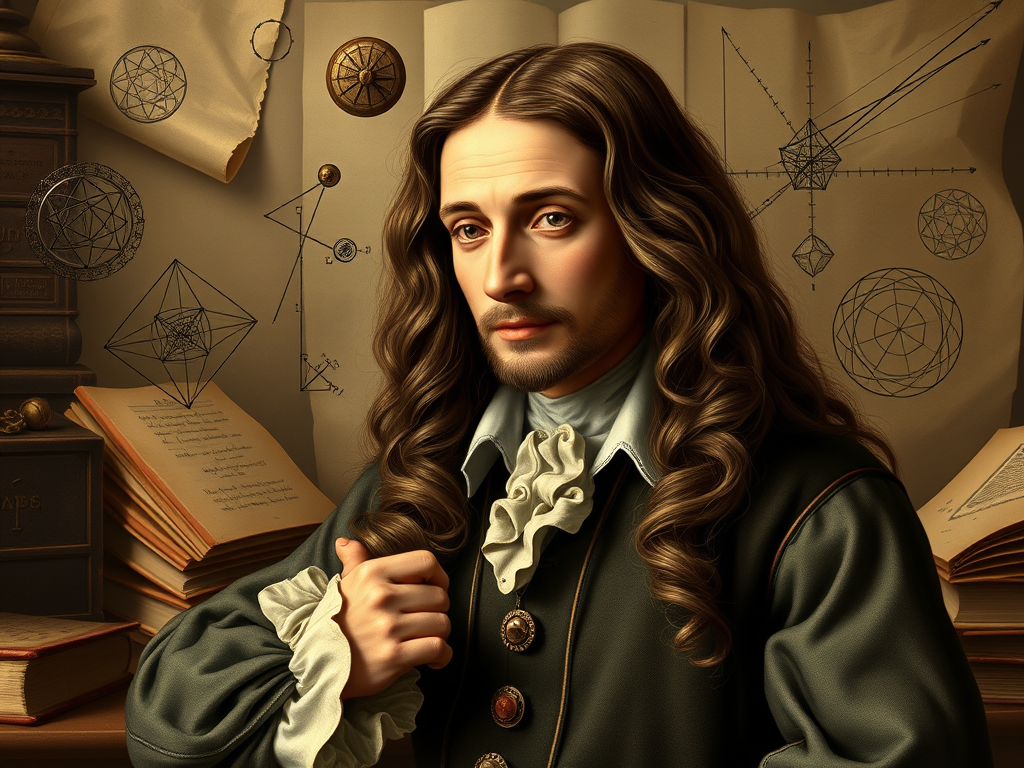
In this episode, we explore the short but brilliant life of 17th-century polymath Blaise Pascal, a child prodigy whose work spanned geometry, fluid dynamics, and theology,. We discuss his early inventions, including the Pascaline—a mechanical calculator created to assist his tax-collector father—and his correspondence with Pierre de Fermat that established the foundations of probability theory,.
Discover how Pascal challenged the scientific status quo by proving the existence of a vacuum and establishing the principles of hydraulic pressure, leading to the SI unit of pressure being named in his honor,. We also examine his dramatic “night of fire” conversion, which shifted his focus from science to the defense of the Christian faith, resulting in his literary masterpiece, the Pensées,.
From his famous “Wager” on the existence of God to his role as the inventor of the first public transportation system, join us for a deep dive into the life of the man who described humans as “thinking reeds”,,.
Briefing Document: The Life and Work of Blaise Pascal
Executive Summary
Blaise Pascal (1623–1662) was a French polymath whose monumental contributions spanned mathematics, physics, invention, philosophy, and theology. A child prodigy educated solely by his father, Pascal authored a significant treatise on conic sections at age 16. As an inventor, he developed one of the first mechanical calculators, the Pascaline, to aid his father’s tax work, and later conceived and inaugurated the world’s first public transportation service in Paris. His scientific work was pioneering; he made foundational contributions to the study of fluid dynamics, clarified the concepts of pressure and vacuum, and empirically proved that atmospheric pressure decreases with altitude.
A profound religious experience in 1654 marked a pivotal turn in his life, shifting his focus toward philosophy and theology. He became a key figure in the Jansenist movement, defending it against the Jesuits in his widely influential satirical work, The Provincial Letters. His most famous theological work, the posthumously published Pensées, is a collection of fragments intended as a defense of Christianity, containing the renowned probabilistic argument for belief known as Pascal’s Wager. He is remembered as a master of French prose, a dualist philosopher who challenged the rationalism of Descartes, and a complex figure described by T. S. Eliot as “a man of the world among ascetics, and an ascetic among men of the world.” His legacy is enshrined in the SI unit for pressure (the pascal), a programming language, and his enduring influence on science, philosophy, and literature.
——————————————————————————–
I. Early Life and Prodigious Talent
Blaise Pascal was born in Clermont-Ferrand, France, on June 19, 1623. His father, Étienne Pascal, was a local judge, tax collector, and amateur mathematician. After his mother, Antoinette Begon, died when he was three, his father moved the family to Paris in 1631 and took sole responsibility for his children’s education, never remarrying.
- Extraordinary Aptitude: The young Pascal demonstrated an amazing intellectual ability, particularly in mathematics and science. His father initially tried to keep him from studying mathematics.
- Geometric Rediscovery: By the age of 12, using only charcoal on a tile floor, Pascal independently rediscovered Euclid’s first thirty-two geometric propositions.
- Essay on Conics: At 16, following the work of Desargues, Pascal produced his first serious mathematical work, a short treatise on the “Mystic Hexagram.” Now known as Pascal’s theorem, it states that if a hexagon is inscribed in a conic section, the three intersection points of its opposite sides lie on a single line. The work was so advanced that René Descartes initially believed it was written by Pascal’s father. Upon learning the truth, Descartes remarked, “…but other matters related to this subject can be proposed that would scarcely occur to a 16-year-old child.”
II. Scientific and Inventive Contributions
Pascal was a pioneer in the natural and applied sciences, defending the scientific method and producing groundbreaking results in physics and engineering.
The Pascaline (Mechanical Calculator)
- Motivation: In 1642, at the age of 18, Pascal began work on a mechanical calculator to ease the “endless, exhausting calculations” of his father, who was the king’s commissioner of taxes in Rouen.
- Functionality: Known as the Pascaline, the device was capable of addition and subtraction.
- Production: Over the next decade, Pascal refined his design, building approximately 20 finished machines. Eight are known to survive today.
- Commercial Outcome: The Pascaline was not a commercial success. It was expensive and cumbersome to use, becoming more of a status symbol for the wealthy than a practical tool. Nonetheless, it established Pascal as one of the first two inventors of the mechanical calculator.
Physics: Fluids, Pressure, and the Vacuum
Pascal’s contributions to physics were so significant that the SI unit of pressure is named the pascal (Pa) in his honor.
- Fluid Dynamics: His work centered on the principles of hydraulic fluids. His inventions include the hydraulic press, which uses hydraulic pressure to multiply force, and the syringe. He famously demonstrated that hydrostatic pressure depends on the elevation difference, not the fluid’s weight, through what became known as Pascal’s barrel experiment. By attaching a thin tube to a sealed barrel of water and filling the tube, the immense pressure generated by the small amount of water in the tall tube caused the barrel to leak.
- The Nature of the Vacuum: In 1647, after learning of Evangelista Torricelli’s experiments with barometers, Pascal began his own research. He replicated the experiment and questioned what filled the space above the mercury in the tube, challenging the Aristotelian and Cartesian belief that “nature abhors a vacuum.” His work, Experiences nouvelles touchant le vide (“New experiments with the vacuum”), detailed rules for how air pressure could support liquids and argued for the existence of a true vacuum.
- Atmospheric Pressure vs. Altitude Experiment: Pascal reasoned that if air has weight, its pressure must be lower at higher altitudes. On September 19, 1648, his brother-in-law, Florin Périer, carried out an experiment at Pascal’s request on the Puy de Dôme mountain.
- At the base (Minim Fathers’ monastery): The mercury in the barometer tube stood at 26 inches and 3.5 lines.
- At the summit (approx. 500 fathoms higher): The mercury fell to a height of only 23 inches and 2 lines.
- Conclusion: The experiment, repeated multiple times, decisively proved Pascal’s hypothesis. Pascal later replicated the result on a smaller scale by carrying a barometer up the 50-meter bell tower of the church of Saint-Jacques-de-la-Boucherie in Paris, where the mercury dropped two lines.
Public Transportation System
In one of his last major achievements, Pascal applied his genius to create one of the world’s first land-based public transportation services.
- The Carrosses à Cinq Sols: This service consisted of a network of horse-drawn, multi-seat carriages that traveled along five fixed routes in Paris.
- Operating Principles: Pascal established foundational principles for public transit: a fixed route, a fixed price (five sols), and a regular schedule, with carriages departing even if empty.
- Outcome: The lines were not commercially successful and closed by 1675, but the project established Pascal as the inventor of modern public transportation.
III. Mathematical Innovations
Pascal’s work in mathematics was foundational, particularly in probability theory and number theory.
- Probability Theory: In 1654, prompted by gambling problems posed by his friend the Chevalier de Méré, Pascal corresponded with Pierre de Fermat. Their collaboration gave birth to the mathematical theory of probability.
- They addressed the “problem of points”: how to fairly divide the stakes of a game that ends early based on each player’s chances of winning.
- This discussion led to the introduction of the concept of expected value.
- According to John Ross, “Probability theory and the discoveries following it changed the way we regard uncertainty, risk, decision-making, and an individual’s and society’s ability to influence the course of future events.”
- This work laid important groundwork for Gottfried Wilhelm Leibniz’s formulation of calculus.
- Traité du triangle arithmétique (Treatise on the Arithmetical Triangle): Written in 1654 and published in 1665, this work described a convenient tabular format for binomial coefficients, now universally known as Pascal’s Triangle. In the treatise, Pascal also provided an explicit statement of the principle of mathematical induction.
- The Cycloid: In 1658, while suffering from a toothache, Pascal began studying problems related to the cycloid. When the pain subsided, he took it as a “heavenly sign” to continue his research, completing an essay on the subject in eight days.
IV. Religious Conversion and Theological Works
A profound spiritual transformation in 1654 reoriented Pascal’s life and work, leading to some of the most influential writings in French literature and Christian theology.
Conversion and Jansenism
- “First Conversion”: In 1646, Pascal’s father was treated for a broken hip by two doctors who were followers of Jansenism, a rigorist movement within Catholicism. Through them, Pascal was introduced to Jansenist authors and experienced an initial religious awakening.
- The Memorial: On November 23, 1654, Pascal had an intense, two-hour religious experience which he documented on a piece of parchment that he sewed into his coat and kept with him for the rest of his life. It begins with the word “Fire,” and the declaration: “God of Abraham, God of Isaac, God of Jacob, not of the philosophers and the scholars…” This event marked his “second conversion.”
- Association with Port-Royal: Following this experience, Pascal became deeply involved with the Jansenist convent of Port-Royal, where his sister Jacqueline was a postulant. He spent the next four years traveling between Paris and the convent.
Major Literary and Philosophical Works
- The Provincial Letters (Lettres provinciales):
- Published in 1656–57 under the pseudonym Louis de Montalte, this series of 18 letters was a defense of the Jansenist Antoine Arnauld and a powerful attack on casuistry—a method of ethical reasoning used by the Jesuits that Pascal denounced as a means to justify moral laxity.
- The work’s use of “humor, mockery, and vicious satire” made it immensely popular and influenced later French writers like Voltaire and Jean-Jacques Rousseau.
- It contains the famous apology for verbosity: “The present letter is a very long one, simply because I had no leisure to make it shorter.”
- King Louis XIV ordered the book to be shredded and burned in 1660.
- Pensées (“Thoughts”):
- This collection of fragments, published posthumously in 1669, represents the unfinished material for a planned work titled Apologie de la religion Chrétienne (“Defense of the Christian Religion”).
- It is considered a masterpiece of French prose, hailed by Will Durant as “the most eloquent book in French prose.”
- It contains Pascal’s Wager, a fideistic, probabilistic argument that it is in one’s rational self-interest to believe in God.
- The work also includes the famous aphorism: “Man is only a reed, the weakest in nature, but he is a thinking reed.”
- Philosophy: Pascal is regarded as a major philosopher, remembered for his opposition to the rationalism of Descartes while also rejecting empiricism, preferring fideism (reliance on faith rather than reason).
- He famously criticized Descartes’s mechanistic use of God: “I cannot forgive Descartes. In all his philosophy he would have been quite willing to dispense with God, but he couldn’t avoid letting him put the world in motion; afterwards he didn’t need God anymore.”
- In his philosophy of mathematics, he argued that first principles cannot be proven by reason but must be grasped through intuition, underscoring “the necessity for submission to God in searching out truths.”
V. Final Years and Legacy
Pascal’s later life was characterized by an ascetic lifestyle rooted in the belief that “sickness is the natural state of Christians.” He frequently rejected medical care and devoted himself to serving the poor. His health, which had been poor for most of his life, worsened severely after the death of his sister Jacqueline in 1661.
- Death: Pascal died in Paris on August 19, 1662, at the age of 39. His last words were reportedly, “May God never abandon me.” An autopsy revealed severe damage to his stomach, abdomen, and brain.
- Enduring Legacy: Pascal’s influence is vast and multifaceted.
- In Science: The SI unit of pressure, the pascal, is named for him.
- In Technology: A major programming language, Pascal, and Nvidia’s Pascal microarchitecture are named in his honor.
- In Culture: He is the namesake of universities and has been depicted in films and media, with characters named after him appearing in the animated film Tangled and the video game Nier: Automata.
- In Philosophy and Theology: His work continues to be studied for its insights into faith, reason, and the human condition. In 2023, Pope Francis released an apostolic letter, Sublimitas et miseria hominis, to commemorate the fourth centenary of Pascal’s birth.
Leave a Reply